
S R Gym Adajan
Above Way Wait Restaurant, Kalpana Society Part-2, Choksi Wadi,Adajan, Surat, Gujarat 395009
- Mon–Sat
- 06:00 am – 10:00 pm
- Sunday
- Closed
- Google rating
- 4.6 from 28 reviews
The short answer
Structured strength training lowers long-term blood sugar in adults with type 2 diabetes by around 0.35 to 0.39 percentage points of HbA1c across pooled trials, which is a real and useful effect and is not a reversal. It works best at two or three sessions a week over three to four months. At S R Gym this is coached by somebody holding a special population training certificate, alongside your doctor rather than instead of them. Bring your latest reports and any restrictions your doctor has given you to the first conversation, and keep your medication under their supervision, since it may need adjusting as you get fitter.
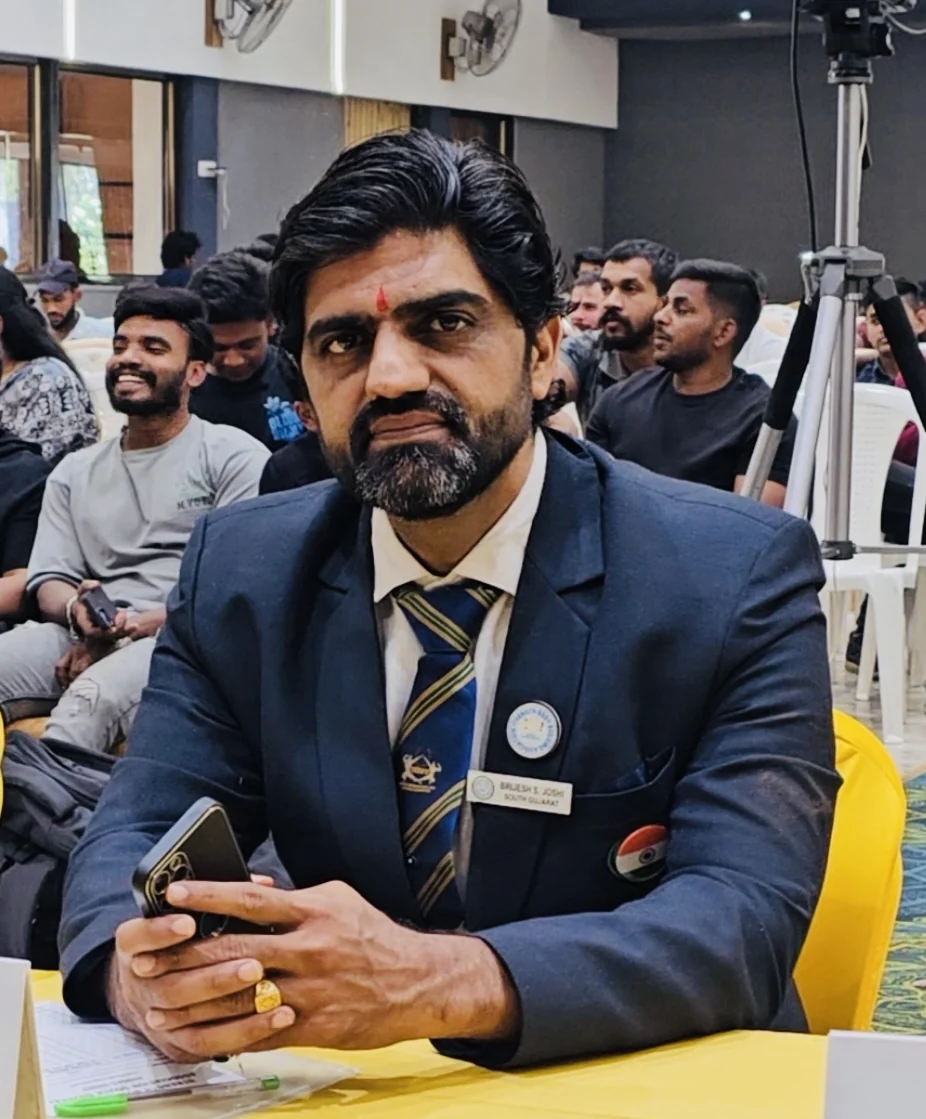
Written byBrijesh Joshi
Founder of S R Gym, Surat, coaching since 1999. President of the Strength Bodybuilding Association South Gujarat and a registered IBBFF judge. See credentials.
A large share of the people who walk into this gym arrive with something on their file. Sugar, blood pressure, cholesterol, or all three. Most of them have been told to exercise by a doctor and given no detail about what that means, and some have been turned away from gyms that did not want the responsibility. This page is what I tell them.
Muscle is where a great deal of the glucose in your blood is taken up and used. Training does two things: it uses glucose during and after a session, and over months it builds more muscle, which gives the body more capacity to handle sugar in the first place. That is the mechanism, and it is why strength training in particular matters here rather than only walking.
The size of the effect is known rather than guessed. Pooled analyses of randomised trials find that structured resistance training reduces HbA1c, the measure of your average blood sugar over roughly three months, by about 0.35 to 0.39 percentage points in adults with type 2 diabetes. Two independent reviews arrive at close to the same number. The clearest results come from programmes running two or three sessions a week for twelve to sixteen weeks, which is a description of ordinary training rather than anything specialised.
For context on why this matters in Surat: the ICMR-INDIAB national study reported diabetes in 11.4 percent of Indian adults, prediabetes in 15.3 percent, high blood pressure in 35.5 percent and abdominal obesity in 39.5 percent. This is not an unusual case for a gym to handle. It is a large share of the city.
You will see that word used a great deal, by apps and by programmes sold online, and it is worth being clear about why it does not appear on this page.
A reduction of around a third of a percentage point in HbA1c is a real improvement in long-term blood sugar control. It is not the same thing as making a condition go away. Some people, with weight loss and consistent training, do reach a point where their doctor reduces or stops a medication. That is a wonderful outcome and it happens. It is a conclusion a doctor reaches by looking at your numbers, and it is not a thing a gym can offer you in advance.
If a coach in Surat promises you reversal before they have seen your reports, what they are selling is confidence rather than treatment. I would rather tell you the smaller true number and let you decide whether it is worth your time. In my experience it usually is, because the blood sugar is rarely the only thing that improves.
Regular exercise lowers blood pressure over time, which is why this is worth doing rather than avoiding. What changes is how the lifting is taught.
Bring to the gym:
Worth asking your doctor before you begin:
Those four questions take two minutes in an appointment and they make the whole thing straightforward afterwards.
Stop a session and get help for chest pain or tightness, pain spreading to the jaw, neck or arm, sudden severe breathlessness, dizziness or feeling faint, or a cold sweat with nausea. These are not signs to push through.
On low blood sugar specifically: shakiness, sweating, confusion, unusual hunger or sudden weakness during a session should be treated immediately with fast-acting sugar, and the session ends there. If you take insulin or a sulfonylurea, carry something sugary with you and tell whoever is coaching you that you do. Do not train alone if your sugar has been unpredictable lately.
And skip the session entirely if you are unwell, if your sugar is very high or very low before you start, or if you have an unhealed foot wound. Foot care matters here in a way it does not for other members, and footwear that rubs is worth taking seriously.
Dr Mahesh Kumar's Medical Institute
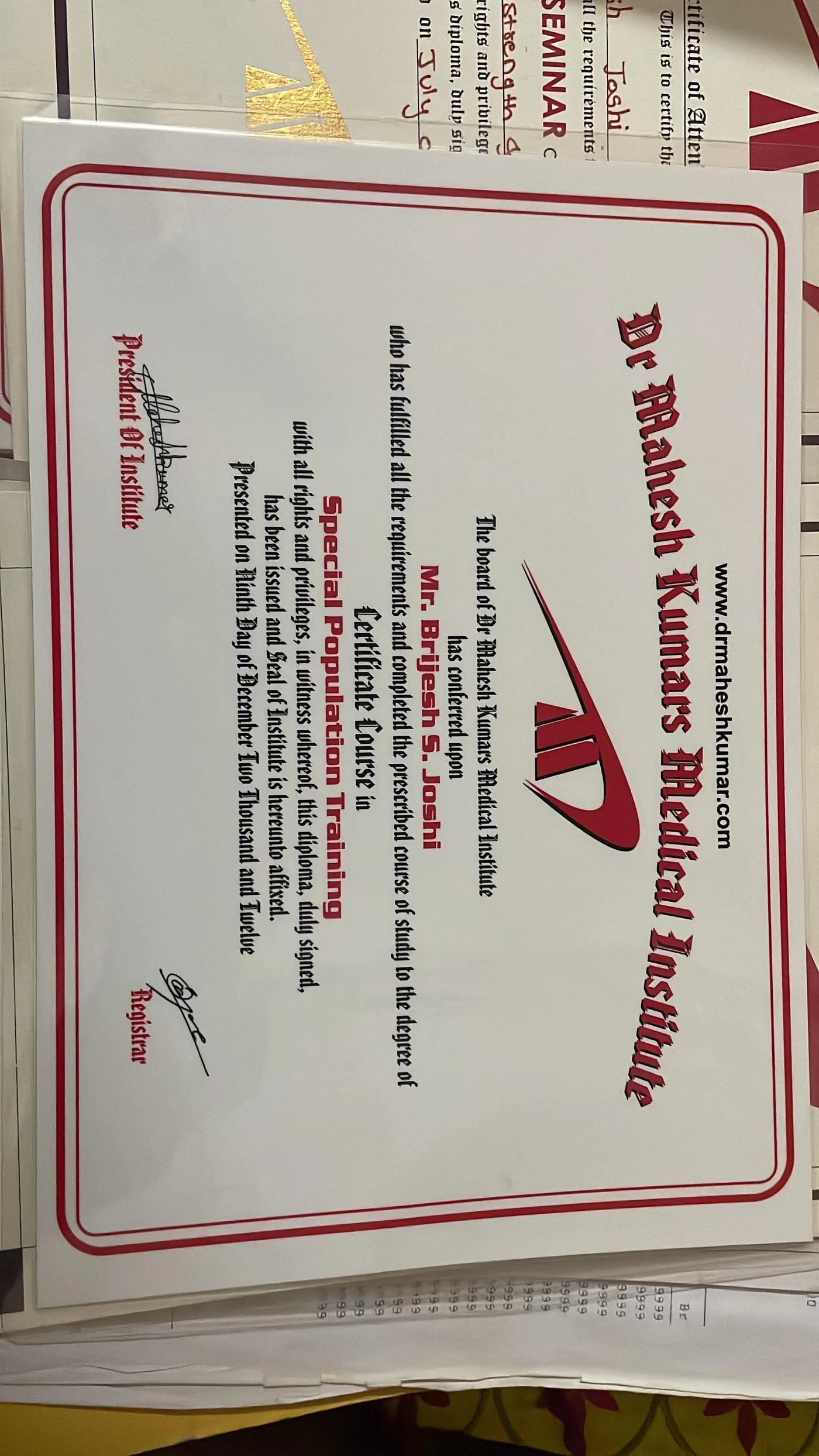
Training somebody with a medical condition is a different job from training somebody without one, and a gym should be able to show why it is qualified to do it rather than simply assert that it is.
Brijesh Joshi holds a special population training certificate from Dr Mahesh Kumar's Medical Institute, covering training for people with additional medical or physical considerations, alongside personal training certification from GFFI, a functional training qualification from the Energy Kettlebell Fitness Academy Asia, and a first aid and CPR component in the trainers' course he teaches on.
Every certificate is photographed and shown onthe credentials page, with the ones awaiting a scan listed separately and marked as such.
What that qualification does not make him is a doctor, and this page is written on that basis throughout.
The effect sizes on this page are stated as the trials found them, including where that number is smaller than a reader might hope. Nothing here is a treatment claim.
Effects of resistance training on glycaemic control in adults with type 2 diabetes
Pooled analysis of randomised trials, PMC8915309, 2022 · Systematic review and meta-analysis of randomised trials
Resistance training reduced HbA1c by roughly 0.35 to 0.39 percentage points in adults with type 2 diabetes, with the clearest effects from programmes running two to three sessions a week over twelve to sixteen weeks. That is a real improvement in long-term blood sugar control and it is a modest one, which is why it belongs alongside medical care rather than in place of it.
Resistance training and glycaemic control: a second independent meta-analysis
European Journal of Preventive Cardiology, supplement, 2023 · Systematic review and meta-analysis
An independently conducted review reached a very similar figure for the HbA1c reduction achievable with resistance training. Two separate reviews arriving at the same modest number is the reason this page states an effect size rather than a promise.
The Lancet Diabetes & Endocrinology, 2023 · National cross-sectional study
Among Indian adults, the study reported diabetes in 11.4 percent, prediabetes in 15.3 percent, hypertension in 35.5 percent and abdominal obesity in 39.5 percent. This is the context for why a gym in Surat should be able to talk about this competently rather than send people away.
Membership starts at ₹5,000 for 3 months. For most people arriving with a medical condition,personal training is the better starting point, since it means every session is supervised and the programme is built around your reports. That starts at ₹25,000 for 3 months.Full fees.
This page is general information written by a fitness coach holding a special population training certificate. It is not medical advice, it cannot tell you anything about your own condition, and nothing on it should be used to change medication. Speak to your doctor before starting, and keep seeing them once you have.
The first conversation costs nothing and it decides most of what follows. Call +91 98790 69960.