
S R Gym Adajan
3rd floor, above Way Wait Restaurant, near Deepa Complex, Krishna Nagar Society, Kalpana Society Part-2, Choksi Wadi,Adajan, Surat, Gujarat 395009
- Mon–Sat
- 06:00 am – 10:00 pm
- Sunday
- Closed
- Google rating
- 4.6 from 28 reviews
The short answer
I do not sell a free trial pass at S R Gym. There is a paid day pass at ₹300 a day at either branch in Surat, Gujarat, and it is meant for a visitor who needs a floor for an hour rather than for somebody deciding whether to join. What costs nothing is the visit itself: come to Adajan or Katargam during opening hours, stand in the room while a session is actually running, and ask me whatever you want to ask before any money is discussed. If you want to train before you decide, ring or message me on +91 98790 69960 first, so we can pick an hour when I am coaching at that branch and I can tell you on the call what that session involves and what it costs. Both branches are closed every Sunday, so plan the visit for a weekday or a Saturday.
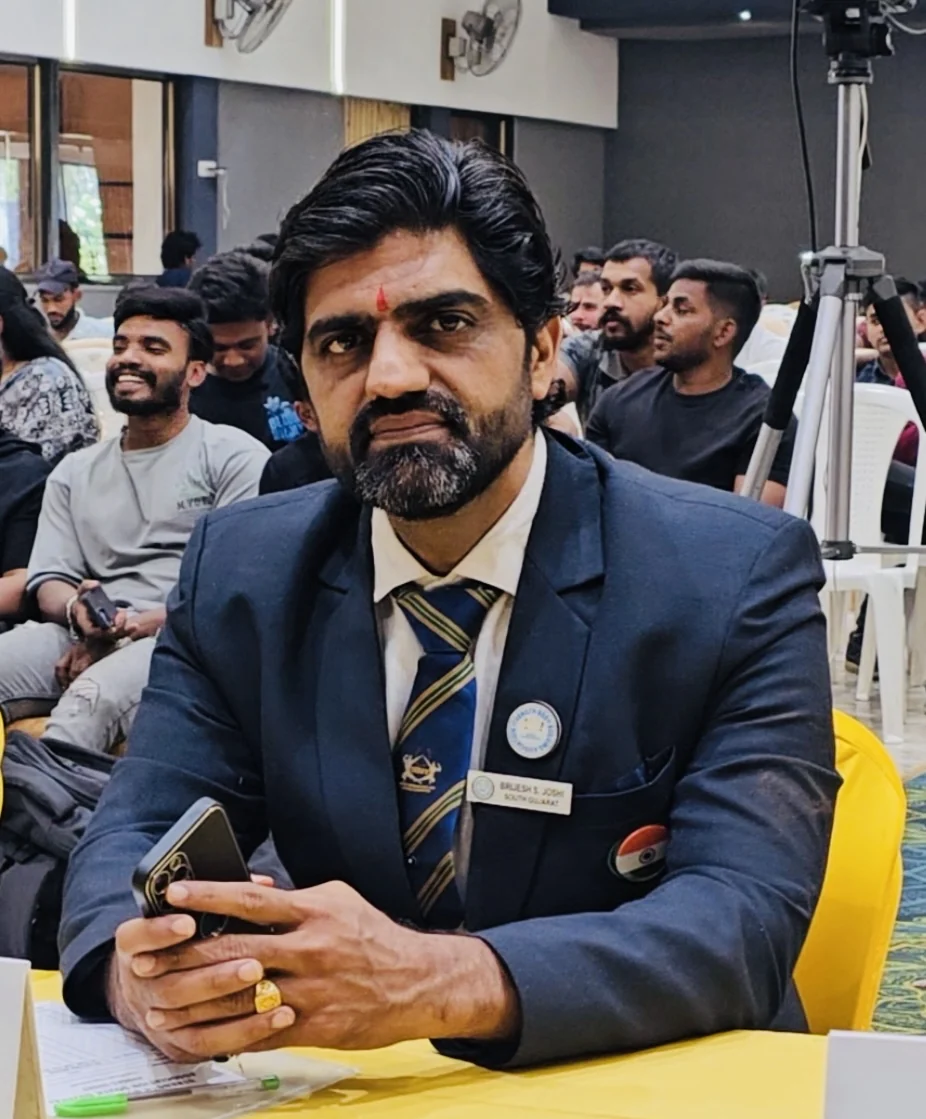
Written by Brijesh Joshi
Founder of S R Gym, Surat, coaching since 1999. President of the Strength Bodybuilding Association South Gujarat and a registered IBBFF judge. See credentials.
Plenty of gyms in this city will not tell you what a first visit involves until you are already standing at the desk with your shoes on, so here is the whole of it in writing, including the parts that may not suit you and the one thing I do not sell.
There is no free trial pass at S R Gym. I have never printed one, and I would rather you read that in the first line of this page than drive to Adajan expecting something I do not have.
There is a day pass, at ₹300 for the day at either branch. It is a real product and I will sell you one, but I would rather tell you what it is for before you buy it.
What costs nothing is the visit itself. You can come to either branch during opening hours, stand in the room while a session is actually running, watch how people are being coached rather than how they are being sold to, and ask me anything you want to ask before a single rupee is discussed. That has been true since I opened in 1999 and it will be true on the day you walk in.
If you want to train before you decide, that is arranged one person at a time. Ring or message me on +91 98790 69960, tell me which branch is closer to you and which hour of the day you can realistically come, and I will tell you on that call what the session will involve and what it costs. Answering the money question before you travel seems the decent way round.
It is the wrong purchase if what you are actually doing is deciding whether to join. The gym I run is built around a conversation, a written programme and a coach who changes it as you go, and almost none of that survives being handed over in one unsupervised hour. You would pay ₹300 to learn less than you would learn for nothing by standing in the room for twenty minutes while a session runs. I would rather say that than take the ₹300.
If you are visiting Surat rather than deciding, the pass is exactly the right thing and you are welcome. What is on the floor at each branch, the opening hours, directions, and the point at which a month becomes cheaper than the passes are all set out on the day pass page.
A visit that is only a look around and a conversation is finished inside half an hour. A visit that includes a supervised session runs to about 90 minutes from the door to the door. Nothing is signed while you are standing there, and nobody follows you to the stairs with a form.
| Stage | What happens | How long | What you do |
|---|---|---|---|
| Before you come | You ring or message me and we agree a branch and an hour when I am there. | 2 minutes | Say which branch is nearer and what time of day you can train. |
| Arriving | You come up the stairs and ask for me at the desk. There is no reception queue and no tour script. | 5 minutes | Arrive in clothes you could train in, in case you decide to. |
| Seeing the floor | You see the room with a session in progress, the racks, the bars, the changing area and how crowded it is at that hour. | 10 minutes | Come at the hour you would actually train, not at a quiet hour I have chosen for you. |
| The conversation | I ask what you have trained before, what your work and sleep look like, what you eat, what hurts and what medication you take. | 15 to 20 minutes | Answer honestly, including the parts you would rather round off. |
| Yoga and Surya Namaskar | Every session at both branches opens with yoga and the twelve positions of Surya Namaskar before any weight is touched. | 5 minutes | Follow along at whatever range of movement you have today. |
| On the floor | If we have arranged a session, I take you through a small number of basic movements with light weight while I watch how you move. | 30 to 40 minutes | Stop when I say stop. A first session should leave you able to walk down the stairs comfortably. |
| Afterwards | Fees, terms, what a training week would look like for you, and what I think is realistic in three months. | 10 minutes | Go home and think about it. The rate will be the same next week. |
Timings are what a first visit usually takes, and a busy hour can stretch them. If you have somewhere to be, tell me when you arrive and I will keep to it.
Every chain you have looked at has an online booking form, and this site does not have one. The honest reason is arithmetic. There is one of me and there are two branches in different parts of Surat, and I coach on the floor at both of them, so a form would cheerfully book you for Thursday at 7am at Adajan on a morning when I am at Katargam. You would climb the stairs, meet a polite stranger at the desk and leave with the impression that this place is like every other place.
A message on WhatsApp settles it in half a minute, because I can look at the week and give you an hour when I will be standing in that room. The thing you are actually here to assess is the coaching, and the coaching is a person, so booking around that person is the only way you get to assess it. WhatsApp and the telephone are the two channels this business runs, and the number for both is +91 98790 69960.
I realise a form is easier at 11pm when you have finally decided to do something about it. If that is the moment you are reading this, send the WhatsApp message then and leave it. I answer in the morning, and nobody rings you back four times to close a sale. If you would rather read answers than talk to anyone yet, the frequently asked questions page and the guide to choosing a gym in Surat cover most of what people ask me before they come.
Nobody in Surat writes this down, so people arrive in office shoes and spend the hour worrying about it. Here is the whole list, and it is short on purpose.
What to wear
What to bring
On food, come two to three hours after a proper meal, or eat something light about 45 minutes before if you are training early. Drink water because an hour of work will make you thirsty, and leave it at that, because the claims you have read about water and cramp are far less settled than the people selling you electrolytes suggest. If you are training at 5am at Katargam and the idea of eating first turns your stomach, tell me and we will work around it.
It opens the way every session at both branches has opened since 1999, with yoga and the twelve positions of Surya Namaskar before any weight is touched. It takes about five minutes, it warms the body, and it takes the spine, hips, shoulders and ankles through their range while nothing is loaded. New members find this odd for roughly a week and then stop noticing.
After that I want to see you move. Usually that means a squat pattern, a push, a pull and something for the middle, with light weight and low repetitions, while I watch your hips, your knees and how your ribs sit. I am learning what you can do today rather than testing what you could do at your best, so the session ends while you still have plenty left. I would rather you walked out slightly disappointed at how easy it was than could not sit down properly on Wednesday.
Here is the honest limit of what one supervised session does. A 2022 systematic review in the International Journal of Strength and Conditioning pooled 12 studies and found supervised resistance training produced a moderate advantage in strength, 0.40 with a confidence interval running from 0.06 to 0.74, and a trivial effect on body composition, 0.07 with a confidence interval that crosses zero. Every one of those studies ran for 12 weeks or longer, so none of them describes a single session at all. What a supervised first session genuinely gives you is that somebody shows you the movements and sets your starting weights instead of you guessing, and my own coaching judgement, which is a judgement rather than a research finding, is that the guessing is where a lot of beginners lose their first few months.
On safety, I am not going to quote you an injury rate for gym training, because published figures vary so widely between studies that any single tidy number would be picking a favourite. What I will say, and this is an observation from running a gym floor since 1999 rather than a research finding, is that the first weeks are where I see people hurt themselves, usually by loading a movement they have not yet learned. That is the whole argument for starting light with somebody watching. If you want to know what the following months look like, the guide to your first 90 days in the gym sets it out week by week.
Golden rules for the gym
The rules I give every new member, recorded in 2020 and the first video I put on YouTube. Seven minutes, and worth watching before you come.
A visit costs you an hour and some petrol, so it is worth knowing in advance whether you are the person this suits. The second list is the one I would want to read if I were you.
Who this is for
Who this is not for
The reason a free trial is so easy to find at a large chain and so hard to find at a place like mine has nothing to do with confidence. A chain sells access to a room, and a trial pass is simply the cheapest way to get you through the door and into the app. The pass is the sales process, it is automated, it works at midnight, and for a great many people it is a perfectly sensible thing to buy.
A budget chain is the better choice for you when you already know how to train, when you want the lowest possible monthly figure, when you need somewhere open on Sunday, or when you travel and want the same card to work in four cities. I have no interest in talking you out of that. I will say what you give up, which is that nobody watches your first set, nobody notices when your programme stops progressing in week nine, and the trainer who showed you round in January may have moved on by March.
A coached gym sells the coach, and that is why the trial here is a conversation and a supervised hour rather than a door code. The trade-off runs the other way too, honestly stated. You pay more, you have to ring a person, we are shut on Sunday, and there are only two branches. The way to decide between the two categories is to work out which of those two failures would actually stop you, being ignored on the floor or having to make a phone call, and choose against that one. The page on gym fees in Surat sets out what the different tiers in this city usually cost and what comes with them.
Membership starts from ₹1,700 for one month, and personal training with me starts from ₹10,000 for one month, charged on top of a membership. The whole rate card, including the day pass, the couple rate and online coaching, sits on the membership fees page. Adajan opens at 6am and Katargam opens at 5am, Monday to Saturday, and both branches are closed every Sunday, which you can check against the timings page before you set off.
If you would like to know who is coaching you before you come, my credentials are published with the certificates photographed, including the ones that have lapsed. Women considering a first visit may find the page on training for women in Surat useful, and anyone weighing up one-to-one work can read what personal training here actually involves before spending the money on it.
Under the current American College of Sports Medicine screening guidance, most adults with no symptoms and no diagnosed heart, metabolic or kidney disease are not asked to get medical clearance before starting to train, and ACSM changed that guidance in Medicine and Science in Sports and Exercise in 2015 to stop unnecessary doctor referrals from becoming a barrier to people beginning at all. I am describing what that guidance says rather than giving you medical advice, and you know your own history better than a web page does. If you have diagnosed heart, metabolic or kidney disease, or you get chest discomfort, unusual breathlessness, dizziness or palpitations, speak to your doctor before your first session and bring me whatever they say. That applies squarely to members with diabetes, and the page on training with diabetes in Surat goes into how we work around it.
On the risk of training itself, the honest numbers help more than reassurance does. A New England Journal of Medicine study from 2000 followed 21,481 men and recorded roughly one sudden cardiac death for every 1.51 million episodes of vigorous exertion. The relative risk during and just after exertion was raised, and it was substantially lower among the men who exercised habitually. That cohort was American male physicians aged 40 to 84, so it does not transfer cleanly to Indian men and women, to younger trainees, or to a South Asian population that carries cardiovascular risk at a lower body weight. My reading of it, and this is my coaching judgement rather than anything the paper claims, is that a first session belongs at a light intensity with somebody watching, which is exactly how I run them.
For what a sensible week eventually looks like, the World Health Organization's 2020 guidelines in the British Journal of Sports Medicine put the adult baseline at 150 to 300 minutes of moderate activity a week, plus strengthening work for the major muscle groups on 2 or more days. WHO itself grades much of that evidence as moderate to low certainty, so treat it as the international baseline rather than a prescription for you. Three sessions a week is where most of the members I coach settle.
Four sources are cited on this page. Each entry says what the study actually found and how strong it is, so you can weigh it yourself rather than take my word for it.
Updating ACSM's Recommendations for Exercise Preparticipation Health Screening
Medicine & Science in Sports & Exercise, 2015 · Expert guideline revision
ACSM removed cardiovascular risk-factor profiling from its screening algorithm because the older guidance produced excessive physician referrals that were themselves becoming a barrier to people starting exercise. Screening now turns on current activity level, known cardiovascular, metabolic or renal disease or its symptoms, and the intended intensity.
Triggering of Sudden Death from Cardiac Causes by Vigorous Exertion
New England Journal of Medicine, 2000 · Prospective cohort, 21,481 men followed for 12 years
The absolute risk was roughly one sudden cardiac death per 1.51 million episodes of vigorous exertion. The relative risk during and shortly after exertion was raised, and it was substantially lower in men who exercised habitually. The cohort was American male physicians aged 40 to 84, so it does not transfer cleanly to Indian men and women or to younger trainees.
The Role of Supervision in Resistance Training: an Exploratory Systematic Review and Meta-Analysis
International Journal of Strength and Conditioning, 2022 · Systematic review and meta-analysis of 12 studies
Supervised resistance training showed a moderate advantage for strength, 0.40 with a confidence interval of 0.06 to 0.74, and a trivial effect on body composition, 0.07 with a confidence interval crossing zero. Every included study ran for 12 weeks or longer, so none of it describes what one supervised session achieves.
World Health Organization 2020 guidelines on physical activity and sedentary behaviour
British Journal of Sports Medicine, 2020 · International guideline
Adults are advised to accumulate 150 to 300 minutes of moderate or 75 to 150 minutes of vigorous aerobic activity a week, plus muscle-strengthening work covering the major muscle groups on 2 or more days. WHO grades much of the underlying evidence as moderate to low certainty, so it is a population baseline rather than an individual prescription.
Send me a message with the branch that is nearer to you and the hour you can come, and I will tell you when I am on the floor there. You can also call +91 98790 69960 between 5am and 10pm from Monday to Saturday, and ask for me by name, Brijesh Joshi.