
The S R Gym method
The short answer
Six things decide almost everything, and I have taught them the same way since 1999. Open every session with Surya Namaskar and a few minutes of yoga so the body is warm and the joints move properly. Get the movement right before you add weight to it. Turn up on Monday, because the week you skip Monday is the week you lose. Build the diet from real food and treat supplements as a convenience rather than a foundation. Sleep and rest properly, because muscle is built between sessions and not during them. And stay away from steroids, whatever the person next to you is doing.
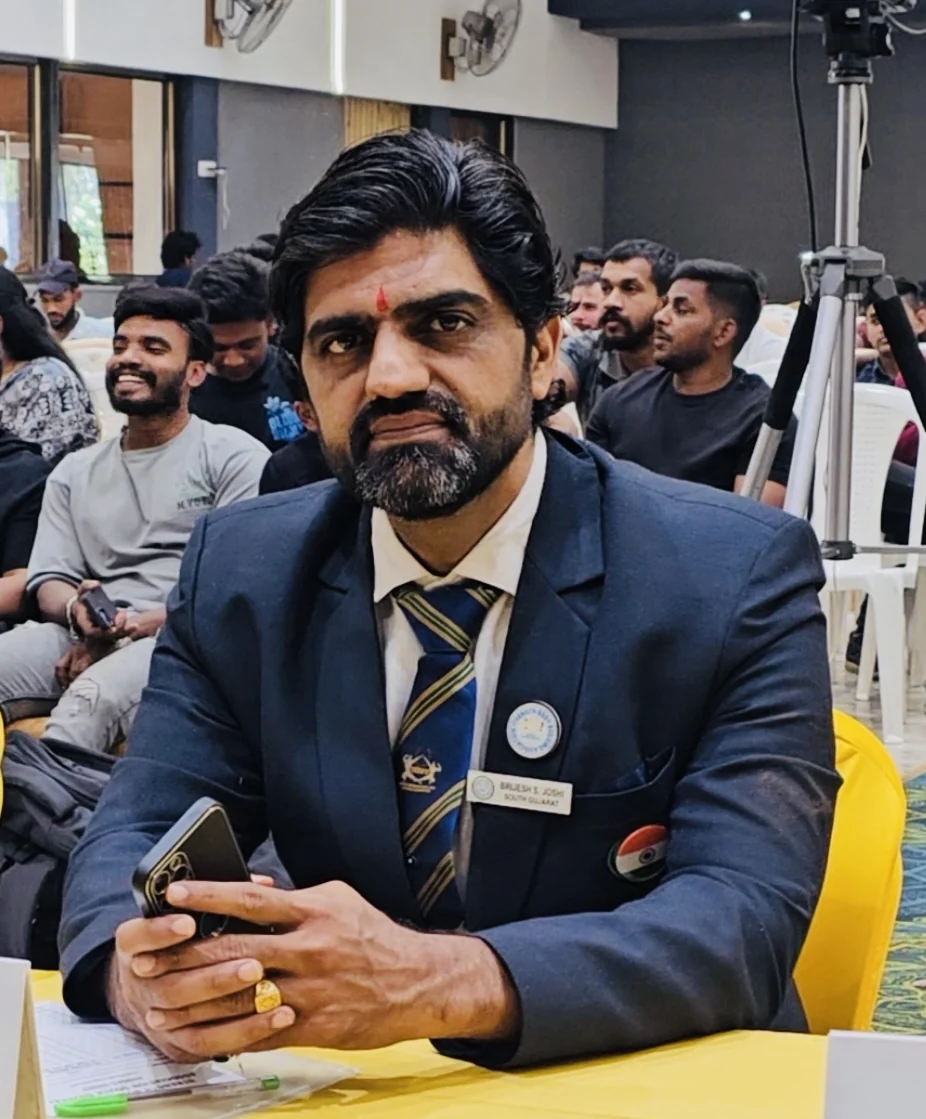
Written byBrijesh Joshi
Founder of S R Gym, Surat, coaching since 1999. President of the Strength Bodybuilding Association South Gujarat and a registered IBBFF judge. See credentials.
- Published
- Reading time
- 8 min read
I have been training since 1991 and coaching in Surat since 1999. Somewhere around 12,000people have come through these two floors in that time, and what I teach them has barely changed. The equipment has been replaced twice over and the music on the floor belongs to a different generation, but these six things have stayed exactly where they were, because they are the ones that keep working.
01
Yoga and Surya Namaskar first
Twelve poses before you touch a weight. It warms the body, opens the hips and spine, and settles the mind before a session rather than after it.
02
Form before load
The weight goes up when the movement is clean and not before. A lift you cannot control is not a lift you own.
03
Never skip Monday
Consistency compounds and enthusiasm does not. Protect the first session of the week and the rest of it follows.
04
Real food, then supplements
Dal, curd, milk, paneer, eggs, sabzi. A shake fills a gap on a busy day. It does not build a diet.
05
Sleep, rest and stillness
Training is the stimulus. Sleep is where the adaptation happens. Rest days and a few quiet minutes are training too.
06
No steroids
I have judged bodybuilding at state and national level for years. I have also seen what people do to their bodies chasing a shortcut, and I will not coach it.
Every session opens with yoga
The first thing I ask anyone to do when they walk onto the floor is Surya Namaskar. Twelve poses, moving with the breath, before a single weight is picked up. Most gyms in Surat put a new member on a treadmill for five minutes and call it a warm-up. I have never understood what that is supposed to prepare.
Think about who is actually walking in. Somebody who has been at a desk or behind a counter for nine hours, whose hips have been folded the whole time, whose upper back has been rounded over a screen, and whose shoulders have not been above their head all day. Ask that body to squat or press straight away and it will find a way to do it, but it will find that way by borrowing range from somewhere it should not.
Surya Namaskar takes the spine into extension and flexion, opens the hips, loads the shoulders overhead, and stretches the calves and hamstrings, in one sequence, in about four minutes. It raises the body temperature. And it asks for a little attention, which matters more than people expect, because somebody who arrives distracted trains badly and gets hurt.
I am a certified yoga trainer as well as a fitness trainer, which is why this is a taught routine here rather than a suggestion. Members learn the twelve positions properly in their first fortnight. There is a fuller explanation of the sequence and what it does on theSurya Namaskar and weight training page.
Form before load, without exception
The most common thing I correct is not a wrong exercise. It is a right exercise carrying more weight than the person can control. Somebody loads a bar because the man beside them has that much on it, then bends at the wrong joint to move it, and repeats that four hundred times over a month.
The rule I use is simple enough to apply without me standing there. If the last repetition of a set does not look like the first one, the weight is too heavy for today. Not forever. Today. Take it off, finish the set properly, and add it back next week when the movement holds.
This is the least popular rule I have, especially with young men in their first three months, and it is the one that decides who is still training at forty. A shoulder or a lower back that has been ground down by years of sloppy repetitions does not announce itself at twenty-two. It announces itself later, and by then the habit is very hard to unlearn.
It is also why I coach on the floor rather than from a desk, and why somebody on apersonal training plan gets corrected on every set rather than handed a printed chart.
Golden rules for the gym
The rules I give every new member in their first week, in Hindi. This was the first thing I put on the channel.
Never skip Monday
I can usually tell in the third week whether somebody will still be here in the sixth, and the signal is not how hard they train. It is whether they came on Monday.
A missed Monday is rarely just a missed session. The week arrives without its anchor, Tuesday becomes the day you will start, Wednesday gets busy, and by Thursday the week is written off and the plan restarts next Monday. That cycle can eat a year. I have watched it eat several.
So the instruction I give is narrow on purpose. Protect Monday. If the session has to be forty minutes instead of ninety, take the forty minutes. If you are tired, come and do the warm-up and two easy movements and go home. What you are protecting is the habit, and the habit is the thing that produces results over a year. Enthusiasm gets people through February. Structure gets them through August.
Twelve sessions in a month done adequately will always beat eight sessions done perfectly. There is no version of this where the person who trains more consistently loses.
Food first, supplements last
A new member asks me about protein powder within the first week almost every time, and usually before they have told me what they eat. My answer has been the same for twenty-five years. Show me the plate first.
Most of the people I coach are vegetarian, and a normal Gujarati day is generous with carbohydrate and oil and thin on protein. Fixing that does not require anything imported. Dal at both meals rather than one. Curd with lunch. A glass of milk. Paneer twice a week. Chana or rajma in place of one shaak. Eggs if you eat them. Do that honestly for a month and most people are eating thirty or forty grams more protein a day than they were, with no new products at all.
Then, if a working day genuinely leaves a gap, a scoop of whey is a sensible convenience. That is all it is. It is not a foundation, it is not what builds the muscle, and the supplement aisle sells a great deal of nothing to people who are not sleeping and not eating dal. I teach supplement and steroid awareness on a certificate course for trainers, and a good part of that lecture is about what to leave on the shelf.
The detail is onprotein for Indian vegetariansand onlosing fat on a Gujarati diet.
Rest is part of the training
Training is a stimulus. It does not build anything by itself. The building happens afterwards, mostly while you are asleep, and somebody training six hard days a week on five hours of sleep is doing the stimulus part enthusiastically and the building part barely at all.
Three things sit under this. Sleep, first and by a distance. Seven hours or more is what the sleep societies recommend for adults, and the research does show that a night of poor sleep reduces training performance, particularly for an evening session. Getting that right is worth more than anything on a supplement shelf. Second, actual rest days, which are part of the programme rather than a failure of it. And third, a few quiet minutes, whether you call it meditation or simply sitting still after the session with your eyes closed and your breathing slow.
That last one gets the most resistance and I keep asking for it anyway. Most of the people I train carry a good deal of stress, from work, from family, from money, and stress is rarely kind to appetite or to sleep. I will be straight that the research on meditation is a good deal weaker than the research on sleep. Reviews find moderate evidence that it helps anxiety and low mood and little evidence that it changes body weight. So I ask for five quiet minutes at the end of a session as something that has helped a lot of the people I coach, and as my own practice, rather than as a finding I can put a study behind.
No steroids, and why I say it out loud
I have judged bodybuilding at district, state and national level, and I am registered as a judge with the Indian Body Building and Fitness Federation. I have coached competitors to medals. So this is not the opinion of somebody standing outside the sport.
Anabolic steroids and the other compounds that circulate around gyms cause real harm, and the harm is not evenly distributed or easy to predict. Liver strain, blood pressure, cholesterol moving the wrong way, heart muscle changes, shutdown of the body's own testosterone production, fertility problems, acne and hair loss, and for a lot of young men, mood changes that damage things outside the gym. Much of it is silent while it is happening. What is bought in India is frequently counterfeit or veterinary grade on top of everything else, so the person taking it often does not know what is in the vial.
What I see most often is not a professional making an informed choice. It is a nineteen or twenty-year-old, four months into training, impatient, who has been told by somebody at a gym that everyone does it. The honest thing to tell him is that he has not yet trained or eaten properly for long enough to know what his own body can do, and that he is proposing to spend his health to skip the part that would have taught him.
So I say it plainly to members, I teach it on the certificate course I lecture on, and I say it to competitors I coach. If somebody wants that route, they will have to find it elsewhere. It is the one thing I will not help with.
The full account, with the research on the heart, the liver, fertility and dependence set out with its sources, is onthe page I wrote about steroids in Indian gyms. It includes the findings that make my case weaker as well as the ones that make it stronger.
If you are already using and want to stop, that is a conversation for a doctor rather than a coach, and it is worth having. Stopping abruptly without medical guidance has its own problems.
What a week actually looks like
None of this is complicated to run. For somebody who works a normal job in Surat and wants to be stronger and leaner in a year, the week I would build looks close to this.
- Four training days, fixed in advance. Monday is one of them and it is not negotiable. The other three sit wherever your week actually has room.
- Every session opens the same way. Surya Namaskar and a short mobility sequence, four to six minutes, then the first working movement.
- Compound movements first, while you are fresh. Squat, press, row, pull, hinge. Assistance work afterwards if there is time and appetite for it.
- Weight goes up only when the last repetition still looks like the first. Written down, so it is a decision rather than a feeling.
- Protein at every meal. Sorted at the plate before any product is bought.
- Seven to eight hours of sleep, and two full rest days.These are in the programme, not gaps in it.
A beginner's version of this, week by week, is set out inyour first 90 days. If you would rather have it built around your own schedule and your own kitchen, that is whatpersonal training is for.
Questions about how we train here
- What is the S R Gym training method?
- Every member starts a session with Surya Namaskar and a short yoga sequence, then trains with an emphasis on controlled form before load. The weekly structure is built around consistency rather than intensity, diet is built from ordinary Indian food with protein at every meal, and rest and sleep are treated as part of the programme. Performance-enhancing drugs are not part of it at any level.
- Why does the gym start with yoga instead of a machine warm-up?
- Because most of the people walking in have spent the day sitting, and what they need before loading a joint is for that joint to move through its full range. Surya Namaskar takes a few minutes, moves the spine, hips, shoulders and ankles in sequence, raises the body temperature, and asks for attention on the breath. Members who keep it up almost always report better flexibility, and several have found that long-standing back and neck discomfort settles as they get stronger.
- Do I need to be fit before joining?
- No. A large share of the members here started with no training background at all, and the first two weeks are deliberately easy for that reason. If you have a medical condition, bring it up at the start so the programme can be built around it. Brijesh holds a special population training certificate, and the details are on the credentials page.
- How is this different from other gyms in Surat?
- Most gyms in the city sell access to equipment. The difference here is who is on the floor and what happens in your first month: a coach who has been teaching since 1999, a fixed opening routine, and correction on technique whether or not you have bought personal training. Whether that is worth it to you is a fair question, and the honest way to answer it is to come and watch a session.
- Does Brijesh coach steroid use for competition?
- No. He judges bodybuilding at state and national level and coaches competitors, and the coaching stops at training, diet, posing and recovery. If you want a pharmacological plan, this is the wrong gym, and he will tell you so directly rather than pass you to somebody else.
Come and watch a session
Both branches in Surat. Standing at the side of the floor for twenty minutes will tell you more than any page will. Call +91 98790 69960.