
Strength training in Surat, barbell coaching at S R Gym
A small number of lifts, taught properly, then made heavier on a schedule. It is plain and repetitive, and it is the method that works.
I competed in these lifts before I coached them.
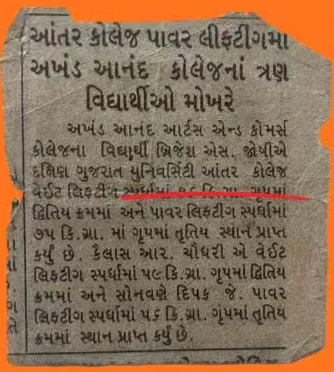
A Gujarati newspaper report records me, then a student at Akhand Anand Arts & Commerce College, placing second in weight lifting and third in the 75 kg group in power lifting at the South Gujarat University inter-college championships in 1997. The cutting is on its own page, with what it says and what it does not.
I am President of the Strength Bodybuilding Association South Gujarat, the body that organises the region's bodybuilding championships, and I served as its Joint Secretary in 2022. Those shows are bodybuilding events, so what a competitive lifter gets from me is the barbell coaching and a straight account of how the regional calendar works. A powerlifting meet entry comes through a separate federation.
Newspaper cutting · 1997
Why a plan beats a workout
A workout is something you did. Training is something you are partway through. The difference is whether there is a plan that says what happens next week and why.
Strength training gives you a number that either goes up or does not. That is uncomfortable and extremely useful, because it makes the question “is this working” answerable in a way that “I feel like I'm getting fitter” never is.
The lifts taught first
- Squat, the whole lower body, and the lift that most people arrive doing badly.
- Hinge, deadlift and its variations, the pattern that moves the most weight, and the one I most often see go wrong when nobody has taught it.
- Press, overhead and bench, upper body pushing, and a test of whether your midsection is doing its job.
- Row and pull, the back work that keeps the pressing honest and the shoulders healthy.
Everything else is accessory work. It matters, and it is arranged around those four patterns.
On the floor those four patterns come out as five barbell lifts. Below is what each one trains and the fault I find myself correcting most often on it. The corrections in the last column are my own coaching judgement from years on the floor rather than a research finding, and the way I teach the squat and the hinge comes from having competed in weight lifting and power lifting myself.
| Lift | What it trains | The fault I correct most often |
|---|---|---|
| Back squat | Hips, thighs and the trunk that has to hold its position while the load sits on your back | The hips rising faster than the chest out of the bottom, which quietly turns the squat into a low back exercise. I take the load off and rebuild the depth before we add weight again. |
| Deadlift and the hinge | The whole back of the body, from hamstrings and glutes through to the upper back and grip, which is why the same pattern sits at the centre of back and posture training | A rounded lower back and a snatched start from a slack bar. I put the bar over the middle of the foot and have you pull the slack out of it before anything leaves the floor. |
| Bench press | Chest, the front of the shoulder and the triceps, with the upper back and the legs holding a stable base | Elbows flaring wide and feet drifting, so the shoulder ends up taking work the chest should be doing. I bring the elbows in and get the feet planted before the set starts. |
| Overhead press | Shoulders and triceps, and it is an honest test of whether the midsection is doing its job | Leaning back through the lower spine to get the bar up. I have you brace the ribs down and finish with the bar stacked over the middle of the foot. |
| Barbell row | The upper back and lats, the work that keeps the pressing balanced and the shoulders healthy | Heaving the bar up with the hips because the weight is heavier than the back can move on its own. I fix the torso angle first and cut the load until it stays fixed. |
Programming: linear first, then blocks
A beginner can add load almost every session for a surprisingly long time, and the correct thing to do is exploit that rather than complicating it. Linear progression continues until it genuinely stops working, which in my experience runs into months.
After that, progress comes in blocks: a period of accumulating volume, then a period of intensifying, then a lighter week. This is where I see self-coached lifters stall most often, because the instinct is to keep grinding when the answer is to back off for seven days.
What is on the floor
Both branches have barbells, plates, racks, benches and the machine work that supports them. This is an old-fashioned gym rather than a chrome-and-mirrors facility, and if what you want is the newest equipment in Surat there are better options, and I will say so on the phone.
Adajan opens at 6:00 am and Katargam opens at 5:00 am. Both close at 10:00 pm, Monday to Saturday, and both are closed on Sunday.
If you want to compete
Tell me at the first conversation. Competing changes how the training is structured, the calendar starts working backwards from a date, and your weight class becomes a planning constraint from the first week. I can tell you how the bodybuilding calendar in South Gujarat works because I preside over the association that organises it, and I will be equally straight about the parts of powerlifting competition that sit outside this gym. You can message me on +91 98790 69960, and bodybuilding competition coaching sets out how a prep block runs.
What it costs
Barbell training is not a separate product with its own fee. It is what an ordinary membership here gets you, because the coaching on the floor is included rather than sold on top: ₹1,700 a month, or ₹9,000 for twelve months at Adajan, which is ₹750 a month. Katargam is ₹10,000 for the year.
That is genuinely enough for most people learning to squat, press, deadlift and row. One-to-one personal training is charged on top and starts at ₹7,000 a month, and it earns its fee when you are preparing for a competition, working around an injury, or have a history of not sticking at it. Every rate is on the fees page.
Who barbell training suits, and who it does not
This is for you if
- You want a small number of lifts taught properly and then made heavier on a written schedule, rather than a different workout every time you walk in.
- You are willing to spend the first few weeks under light load while the squat, hinge, press and row are learned, before any of it gets heavy.
- You can train three or four days a week for months on end, because linear progression needs that long before it is worth anything.
- You want to compete in South Gujarat and would rather ask about the calendar and the weight classes in person than piece it together from a WhatsApp forward.
- You accept that the number on the bar is the measure, and that some weeks it will tell you something you would rather not hear.
Look elsewhere if
- Sunday is the only day you are free, because both branches are shut every Sunday of the year and no arrangement changes that.
- You can only get here between six and nine in the evening and want me standing beside you for every set, because that is the busiest stretch at both branches and I spend most of it moving between people.
- You need a competition-standard platform, calibrated plates and somebody to handle you on meet day. The squat, bench press and deadlift are trained here, and the championships I help organise in South Gujarat are bodybuilding shows, so the competition side of powerlifting is something you will have to arrange yourself.
- You want rehabilitation for a back, knee or shoulder problem that no doctor has examined yet. I am a coach and not a clinician, and that examination belongs before barbell loading.
- You want anabolic steroids or supplements to be part of the plan. I will not coach steroid use and the gym sells no supplements at all.
- You already lift well and need only a rack, plates and a quiet hour, in which case an ordinary membership from Rs 5,000 for three months serves you better than coaching does, and you can train at Adajan or Katargam on that alone.
Strength training FAQ
- Is there a powerlifting gym in Surat?
- S R Gym in Surat trains the powerlifting movements, squat, bench press and deadlift, and a Gujarati newspaper report records its founder Brijesh Joshi competing in weight lifting and power lifting at the South Gujarat University inter-college championships in 1997. It is a strength gym rather than a dedicated competition powerlifting facility, so a lifter preparing for a platform is coached here and enters the meet through a separate federation.
- Can a beginner start with barbell training?
- Yes, and it is the best time to. At S R Gym a beginner spends the first few weeks learning the squat, press, hinge and row with light load before progression starts. In my experience, learning the pattern first is faster overall than correcting it a year later.
- What is the difference between strength training and general gym workouts?
- Strength training progresses a small number of barbell lifts on a written schedule, so you can see whether you are actually getting stronger. A general workout varies exercises session to session, which feels productive but leaves you with no way to tell whether anything improved.
- Will strength training make me bulky?
- Adding a large amount of visible muscle takes years of deliberate eating and training, so it does not happen to anybody by accident. What strength training does for most members is make them stronger and better able to handle load, and the members I coach usually describe the result as looking firmer.
- Do I need to train every day for strength?
- No, three to four sessions a week is enough for most people and it leaves room to recover, which is when the adaptation happens. Six days a week is a common beginner plan and an uncommon beginner habit.
Learn the lifts properly.
Tell me what you are training now and how many days a week you can genuinely hold. That is usually enough for me to say where you should start. You can call +91 98790 69960 or send the message below.
Work out your own numbers
Free, no sign-up, and the arithmetic is explained on each page.