
S R Gym Adajan
3rd floor, above Way Wait Restaurant, near Deepa Complex, Krishna Nagar Society, Kalpana Society Part-2, Choksi Wadi,Adajan, Surat, Gujarat 395009
- Mon–Sat
- 06:00 am – 10:00 pm
- Sunday
- Closed
- Google rating
- 4.6 from 28 reviews
The short answer
Preparing properly for a first bodybuilding show takes twelve to sixteen months, which is my own coaching judgement from the officials' table rather than a research finding. Most of that time is an off-season spent adding muscle, followed by a diet-in of sixteen to twenty weeks at a loss of 0.5 to 1 percent of body weight a week, which is the rate the 2014 review by Helms, Aragon and Fitschen in the Journal of the International Society of Sports Nutrition recommends for protecting muscle while you get lean. I have competitors practise posing weekly from the first month, because it is the part almost everybody leaves too late. I hold a Category B judge card with the Indian Body Building & Fitness Federation and I am President of the Strength Bodybuilding Association South Gujarat, so I coach the preparation and I also sit on the panel that scores it. I will not coach anabolic steroids at any level, and I will tell you plainly which Indian federations actually test and which ones do not.
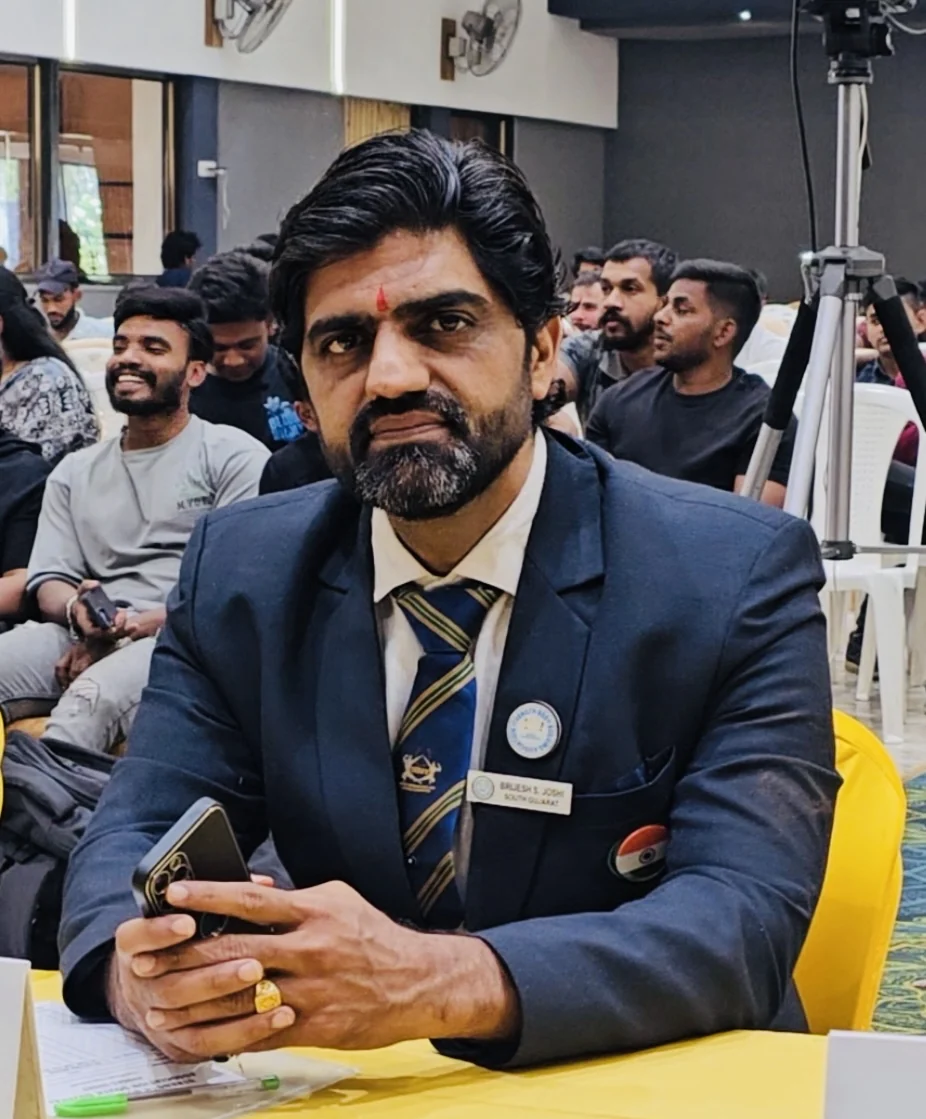
Written by Brijesh Joshi
Founder of S R Gym, Surat, coaching since 1999. President of the Strength Bodybuilding Association South Gujarat and a registered IBBFF judge. See credentials.
I have coached members onto regional stages since the early 2000s, and I have also spent years on the other side of the lights scoring the people standing on them. Almost everything a first-time competitor in Surat gets wrong is something a judge could have told them a year earlier, and this page is me telling you a year earlier.
A bodybuilding show is a comparison of finished physiques, judged against the other people on stage on that particular afternoon. That one sentence explains most of what follows. You cannot arrive with a physique you have not built yet, and no diet, however severe, will conjure muscle that was never there.
So the first requirement is time under the bar, and my position here is my coaching judgement rather than a research finding: you want two to four years of consistent training behind you before a preparation begins at all. After that comes a real off-season of eating enough and training heavy while your weight climbs slowly, then a controlled diet-in of sixteen to twenty weeks, and posing practised the whole way through, because it is a physical skill that takes longer to learn than anybody expects.
There is a further requirement that nobody prints in the advertisements, which is the willingness to give up a certain amount of ordinary life for four or five months. Meals get weighed, social evenings get complicated, and I would rather you knew that before you paid an entry fee than found it out in week fourteen.
If you are still building the base, the honest place to start is muscle gain coaching or strength training, and we can talk about a stage in a year or two.
This is the schedule I run, counted backwards from show day. The twelve to sixteen month figure is my own, drawn from watching first-timers succeed and fail from the judging table, and it sits close to the twelve month structure that experienced natural coaching groups publish. The sixteen to twenty week diet-in inside it is the one part with proper research behind it, from the 2014 review by Helms, Aragon and Fitschen.
| Phase | Time from show | What we are doing | What we measure |
|---|---|---|---|
| Off-season building | 16 to 6 months | Eat in a small surplus, train heavy on compound movements, add muscle where the category needs it. Posing once a week from the first week. | Weight climbing 0.25 to 0.5 kg a month, and the lifts moving. |
| Choosing the show | 6 to 5 months | Pick the event, the federation and the likely class. Read the circular line by line. Take honest photographs under hard light. | Body weight against the class limits, and condition judged against last year's winners. |
| The diet-in | 20 to 4 weeks | Calories come down in steps, protein stays high, cardio is added slowly and only when the food alone stops working. | 0.5 to 1 percent of body weight a week, weighed at the same hour on the same days. |
| Posing intensified | Final 8 weeks | Twice a week, full rounds, timed, in front of a mirror and a camera, with somebody calling the quarter turns. | Mandatory poses held steady for the full count without shaking. |
| Registration | 6 to 4 weeks | Entry form, federation registration, fees, identity documents and the weigh-in class confirmed in writing. | Closing dates met with days to spare rather than hours. |
| Final week | 7 days | Training volume drops, food and salt and water stay normal, sleep is protected. I do not water cut and I do not use diuretics. | How you look in the morning mirror, and how you feel on your feet. |
| Show day | Day 0 | Weigh-in, tan, the pump-up room, prejudging where the placings are really decided, then the evening final. | Your placing, which is relative to whoever else turned up. |
| Coming back | 1 to 6 months after | Food is restored deliberately on a written plan, training returns to building, and we watch how you are actually coping. | Appetite, mood, sleep, the menstrual cycle where it applies, and strength returning. |
The last row is the one people skip, and it is the row I care about most. The regional calendar and how the shows themselves are run is set out in competing in bodybuilding in South Gujarat.
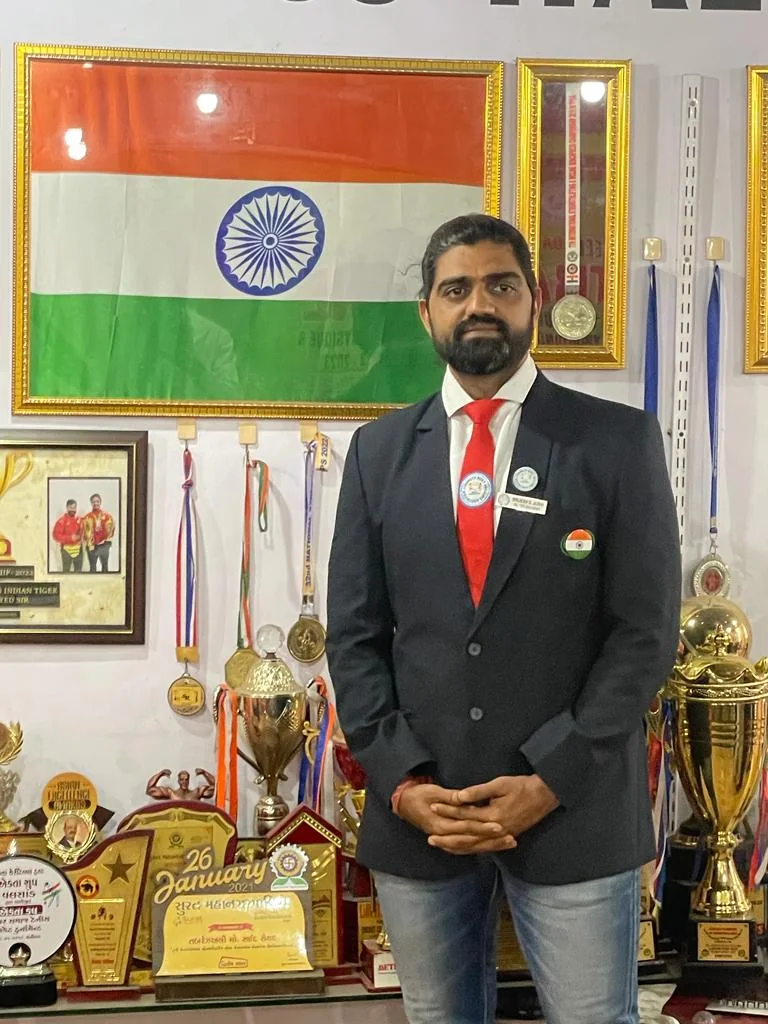
Preparing a competitor is a different job from training a member, and the difference is knowing what a panel actually rewards on the day. Brijesh judges this circuit at zone, state and national level, holds a Category B card with the IBBFF and presides over the association that organises the South Gujarat shows.
That is the reason the posing work on this page is specific rather than general. It is written by somebody who has sat on the panel and marked it.
This is the part of the page with real evidence behind it, so I will give you the numbers as they are published rather than as I feel about them.
The 2014 review by Helms, Aragon and Fitschen in the Journal of the International Society of Sports Nutrition recommends losing 0.5 to 1 percent of body weight a week, and states that preparations longer than two to four months may protect lean mass better than shorter or more aggressive ones. That is the citation behind a sixteen to twenty week diet-in, and it is why I refuse to run a competitor in on eight weeks even when the show is eight weeks away.
The same review reports what has been measured when people rush. In one study it summarises, dropping 1 kg a week instead of 0.5 kg a week across four weeks produced a 5 percent fall in bench press strength and a 30 percent greater reduction in testosterone. That is a single small study rather than a settled law, and it is still a direction I would rather you avoided, because you risk losing the muscle you spent years building and arriving flat.
On the same review's numbers, protein sits between 2.3 and 3.1 grams per kilogram of lean body mass a day through the deficit, fat holds somewhere around 15 to 30 percent of calories, and carbohydrate takes what is left and comes down last. On a Gujarati vegetarian plate that takes assembly, which is covered on protein for Indian vegetarians.
I have competitors pose weekly from the first month of the off-season, and I know that is earlier than most published plans suggest, since the well-known natural coaching guides bring posing up to weekly at around four months out. My reason for starting a year earlier is what I see from the panel. A physique that cannot be presented cannot be scored, and a man holding a front double biceps for the first time in October at a November show is losing marks for something entirely fixable.
What the panel does is comparative. We place you against the other competitors in your class that day on conditioning, muscular development, symmetry and proportion, and presentation. There is no fixed standard you pass or fail, so on a thin day a modest physique wins and on a stacked day the same physique places fifth.
Choosing the right division matters as much as the training does, and it is where a first-timer most often throws away a placing.
Which bodybuilding division suits you
How the divisions work and which one is likely to suit you, recorded in Hindi. Nine minutes, and worth watching before you choose a category.
This is genuinely confusing in India and the confusion is not your fault, because several national bodies exist with acronyms one letter apart. The Indian Body Building & Fitness Federation, written IBBFF, is the body my own judge card is issued under, through its Gujarat unit. The IBBF, the Indian Body Builders Federation, is a separate organisation altogether, and nothing on this site claims a connection to it.
Regionally, the Strength Bodybuilding Association South Gujarat organises the district and area championships in South Gujarat, including the Man of Steel series, Mr. Surat and Mr. South Gujarat. I am its President, so if you are unsure which show suits you, asking me is the shortest route to a straight answer. The state championship above that runs under the Gujarat unit of the IBBFF.
Registration means a federation registration in your name, an entry form for the specific show, the fee, identity documents, and a class confirmed at the weigh-in. Fees are set by the association and they change, so I will show you the current circular rather than print a number here that goes stale. My cards and awards are photographed on the credentials page, including a Gujarat State Bodybuilders Association judges card, number 0010, which ran from 2019 to 2024 and has now lapsed.
I will not coach anabolic steroid use at any level, for any competitor, at any show. That has been my position for as long as I have been coaching and it is not negotiable for a trophy. This gym also sells no supplements of any kind, which removes the usual commercial reason a trainer has for recommending anything at all.
Since I am asking you to accept that, you deserve the reasoning and the strength of the evidence behind it. A 2017 cross-sectional study by Baggish and colleagues in Circulation compared 86 long-term steroid users against 54 non-users and found lower heart pumping function in the users, 52 percent ejection fraction against 63 percent, along with more coronary plaque and a dose-response gradient of roughly 0.60 standard deviations more plaque per 10 years of use. Being cross-sectional, it shows an association with a dose gradient rather than proof of cause, and the HAARLEM study published in 2021 found much of the heart muscle thickening reversed after men stopped.
On the law, get this right, because it is commonly stated wrongly. Anabolic and androgenic substances sit in Schedule H of the Drugs and Cosmetics Rules of 1945, which makes them prescription-only medicines. Selling them without a prescription or a licence is an offence under Section 27 of the Drugs and Cosmetics Act of 1940, and no doctor is legitimately prescribing them so that you can win a district show.
Here is the uncomfortable part I owe you. From what I have seen from the panel, amateur shows in India on the IFBB and IBBFF side are not reliably drug tested, so a drug-free competitor is frequently compared against people who are not drug free. The federations in India that run tested shows include WNBF India and ICN India. If a level field matters to you more than a local trophy, plan towards one of their shows and I will coach you towards it. The longer argument, with the Indian survey data, is on steroids and bodybuilding in India.
Nobody selling contest prep talks about this, and I think that silence is the reason so many first-timers come apart in the month after their show.
The published evidence here is thin and I will not pretend otherwise. In one documented case, a 12-month study by Rossow and colleagues in 2013, a single drug-free male competitor saw his testosterone fall from 9.22 to 2.27 ng/mL during the preparation and recover to 9.91 ng/mL after it, his resting heart rate drop from 53 to 27 beats a minute, and his mood disturbance rise sharply before settling back down. His strength had still not fully returned six months later. Those figures describe one man measured over a year, and across the small number of case studies that exist the picture varies a good deal.
The recovery side deserves saying out loud as well. Across the four case studies Layne Norton reviewed in 2016, weekly weight loss ran between 0.46 and 0.98 percent of body weight, and in one female competitor menstrual function had still not returned more than a year after the show even though her body fat came back within five months. Norton is clear that these are the only peer-reviewed data available on this population, so I offer them as a caution about how long a body can take to settle rather than as a prediction of what will happen to you.
So I coach the way back as deliberately as I coach the way in, and I ask about sleep, appetite and mood every week rather than only about the scale. If you have a history of disordered eating I would like to know before we start, and I would rather work with you on ordinary fat loss coaching than put you through a stage preparation.
I have written this at the level of the category rather than about any particular gym in Surat, because comparing yourself to a named rival is a poor way to choose a coach. Plenty of people have prepared for a first show on their own and placed well. This is what actually differs between the three routes.
| What differs | Coached by somebody who judges | Self-coached from online plans | A general gym floor |
|---|---|---|---|
| Choosing the show and class | You pick it with somebody who has read that federation's circulars for years. | You are guessing from a poster and a WhatsApp forward. | There is usually nobody on the floor to ask. |
| Posing | You pose weekly from the first month, corrected by somebody who scores it. | You learn it from video in the last few weeks. | It is not offered at all. |
| Rate of weight loss | It is held at 0.5 to 1 percent a week and adjusted against the actual trend. | It often runs far too fast in the panic of the final month. | Nobody is managing it at all. |
| Peak week | There is no water cutting and there are no diuretics, and I say so in advance. | You copy it from a forum, and this is the part I most often see go badly wrong. | You get whatever the loudest member on the floor suggests. |
| Drugs | I refuse to coach them, and I name the tested federations honestly. | Somebody offers them informally at most shows. | They are often available from whoever also sells the supplements. |
| After the show | You get a written plan for restoring food, and somebody watching your mood. | You get a rebound nobody warned you about. | There is no plan for it. |
I would rather turn somebody away in September than fail them in March, so the second list here is the more useful of the two.
Who this is for
Who this is not for
The sixteen to twenty week diet-in is well supported. Almost everything published on what a preparation does to a drug-free body comes from a handful of individual case studies, so it is described here as exactly that, and the steroid evidence is an association with a dose gradient rather than proof of cause. Where a claim on this page is my coaching judgement, the page says so in the same sentence.
Journal of the International Society of Sports Nutrition, Helms ER, Aragon AA and Fitschen PJ, 2014 · Narrative review of the contest preparation literature
Recommends losing 0.5 to 1 percent of body weight a week, and states that diets longer than two to four months may be superior for retaining lean mass compared with shorter or more aggressive ones. For the deficit itself it recommends protein of roughly 2.3 to 3.1 grams per kilogram of lean body mass a day and fat at roughly 15 to 30 percent of calories, with carbohydrate taking the remainder. It reports one comparison in which losing 1 kg a week instead of 0.5 kg a week across four weeks produced a 5 percent fall in bench press strength and a 30 percent greater reduction in testosterone. It also calls dehydration and electrolyte manipulation in the final days before a show dangerous, with no established benefit to appearance.
Natural bodybuilding competition preparation and recovery: a 12-month case study
International Journal of Sports Physiology and Performance, Rossow LM and colleagues, 2013 · Case study, one drug-free male competitor
Across the preparation, testosterone fell from 9.22 to 2.27 ng/mL and returned to 9.91 ng/mL afterwards, body fat moved from 14.8 to 4.5 percent and back to 14.6 percent, resting heart rate dropped from 53 to 27 beats a minute, and mood disturbance rose sharply before settling. Strength had still not fully returned six months after the show. This is one man, measured carefully, and it is not a prediction for anybody else.
Lessons learned from recent case studies of drug-tested physique athletes
Biolayne, Layne Norton, 2016 · Review of four published case studies
Reviews the small handful of case studies that exist on natural physique competitors, where weekly weight loss ran between 0.46 and 0.98 percent of body weight. In one female competitor, menstrual function had still not returned more than a year after the show even though body fat came back within five months. The author states plainly that these are the only peer-reviewed data available on this population and that far more is needed.
Cardiovascular toxicity of illicit anabolic-androgenic steroid use
Circulation, Baggish AL and colleagues, 2017 · Cross-sectional study, 86 steroid users and 54 non-users
Users had lower left ventricular ejection fraction than non-users, 52 percent against 63 percent, and a higher coronary plaque volume, with a dose-response relationship of roughly 0.60 standard deviations more plaque for every 10 years of cumulative use. Being cross-sectional, it establishes an association with a dose gradient and does not by itself prove that the drugs caused the damage.
Cardiac effects of anabolic steroid use and cessation, from the HAARLEM study
Frontiers in Reproductive Health, 2021 · Prospective echocardiography study of users through a cycle and after it
Left ventricular hypertrophy and the associated dysfunction seen during use were largely reversible after the men stopped. It is included here as the honest counterweight, because the picture is worse than users admit and better than the frightening version of it.
Competition preparation runs as personal training, which starts at ₹7,000 for one month and covers the programme, the eating, the posing and the weekly adjustments. Gym membership on its own starts at ₹1,700 for one month. Federation registration and entry fees are separate and are set by the association. The full fee page has the detail, and my background says who you would be working with. Katargam opens at 05:00 and Adajan at 06:00, six days a week, closed on Sunday.
This page is general information from a coach and it is not medical advice. A contest preparation is a demanding thing to put a body through, and anybody with a medical condition should speak to their doctor before starting one.
That answer decides whether we are planning a show for this year or building towards one two years out, and I will tell you which of the two it is honestly. Call +91 98790 69960 or send a message, and bring a recent photograph if you have one.
Free, no sign-up, and the arithmetic is explained on each page.