
S R Gym Adajan
Above Way Wait Restaurant, Kalpana Society Part-2, Choksi Wadi,Adajan, Surat, Gujarat 395009
- Mon–Sat
- 06:00 am – 10:00 pm
- Sunday
- Closed
- Google rating
- 4.6 from 28 reviews
The short answer
If you are trying to put on muscle and nothing is happening, the problem is almost always that you are eating too little, and specifically too little protein. Aim for roughly 1.6 grams of protein for every kilogram you weigh, which pooled research across 49 trials found to be the point beyond which more protein adds nothing further, then eat enough total food to gain slowly. Train three or four days a week on compound movements, add weight only when the last repetition still looks like the first, and give it a year rather than a season. A vegetarian Gujarati diet can do this, and it will not happen by accident.
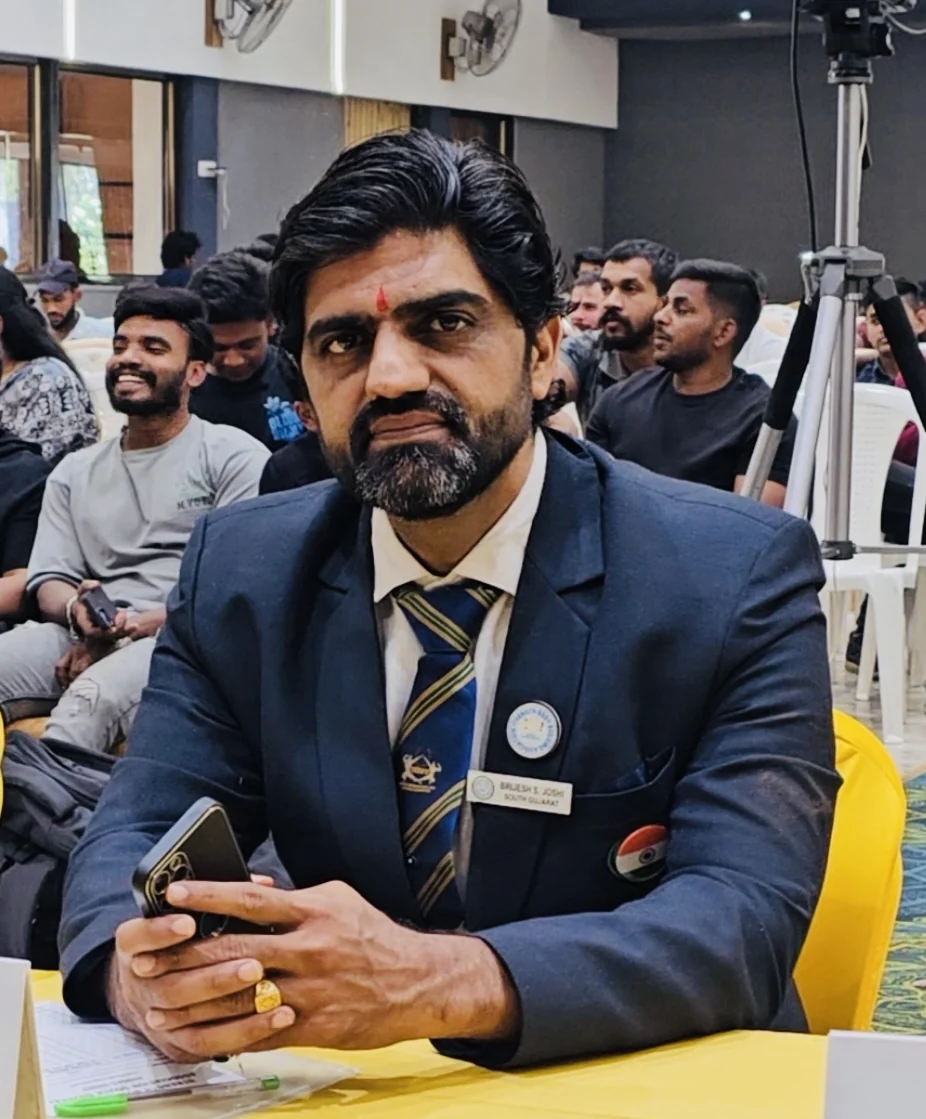
Written byBrijesh Joshi
Founder of S R Gym, Surat, coaching since 1999. President of the Strength Bodybuilding Association South Gujarat and a registered IBBFF judge. See credentials.
The most common enquiry this gym receives is not from somebody wanting to lose weight. It is a young man of twenty-two who weighs fifty-five kilograms, has been training for eight months, and cannot understand why nothing has changed. This page is written for him, and for anyone else who has been eating like a person who is not training.
When somebody tells me they cannot gain, I ask them to write down everything they ate yesterday. Nearly every time, the answer explains itself before we have discussed a single exercise.
Two rotli and a shaak at lunch. Tea at four. Something at nine. Perhaps eight hundred calories short of what a training body needs, and perhaps forty grams of protein when it needs a hundred. Then two hours in the gym four days a week, trying to solve a food problem with effort.
You cannot build tissue out of nothing. The training gives the body a reason to build; the food gives it the material. When either is missing nothing happens, and the one that is usually missing in Surat is the food.
This is one of the few questions in fitness with a genuinely settled answer, so it is worth stating exactly.
The International Society of Sports Nutrition puts the useful range at 1.4 to 2.0 grams per kilogram of body weight per day. A meta-analysis pooling forty-nine trials and more than eighteen hundred people found that above a total intake of about 1.62 grams per kilogram, additional protein produced no further gain in fat-free mass at all. So 1.6 is the number I use, and more than 2.0 is money spent for nothing.
Spread it. The same position stand recommends doses of roughly 0.25 grams per kilogram, or twenty to forty grams, distributed across the day rather than concentrated in one evening meal. Four meals of thirty grams is a better arrangement than one of a hundred and twenty.
Beyond protein, you need a surplus of total calories, and it should be modest. A quarter to half a kilogram of weight gain a month is the rate that puts on muscle rather than fat. Faster than that and you are mostly adding what you will later have to remove.
This is the question I am asked most, usually with a slightly defeated tone, and the answer is better than most people expect.
A twelve-week supervised trial compared habitual vegans against omnivores, with protein matched at 1.6 grams per kilogram for both groups. Both gained, and there was no difference between them on leg lean mass, muscle thickness or strength. Not a small difference. None.
The condition that makes it work is hitting the total, and a normal Gujarati day does not. That is the whole problem, and it is a solvable one. There is also a real Indian detail worth knowing: in cereal-heavy diets, lysine is the first limiting amino acid, which is the research reason behind advice that otherwise sounds like something your grandmother said. Dal, dairy and soya are not just tradition here. They are what closes the gap that rotli and rice leave.
I will also be straight about the caveat. Two meta-analyses find a small advantage for animal protein on percentage lean mass, with soy matching milk protein directly. It is a small edge and it is closed by getting the total right, which is exactly what we work on.
The practical assembly, meal by meal, is onprotein for Indian vegetarians.
Simpler than most people want it to be, and repeated for longer than most people have the patience for. That is the whole method.
The full approach is set out onthe S R Gym method, and the beginner version week by week is inyour first 90 days.
Slower than the internet suggests, and the honest numbers are worth having before you start rather than after you are disappointed.
Strength improves within two or three weeks, which is your nervous system learning the movement rather than new muscle. Visible change usually arrives around three to four months. Other people noticing comes later still, and it tends to arrive as a comment about your shoulders in a shirt rather than anything dramatic.
Over a first year of consistent training and eating, a beginner might add somewhere between four and seven kilograms of lean mass. A second year gives roughly half that, and it keeps halving. This is why the people who end up looking like they train are the people who trained for years, not the people who trained hard for a season.
It is also why I would rather you commit to three sessions a week for two years than six sessions a week for two months.
Some people genuinely find eating difficult, and telling them to eat more is useless advice. What works, practically:
If you have been eating properly for three months and genuinely nothing has moved, see a doctor. Thyroid problems, undiagnosed diabetes and coeliac disease all present this way, and no amount of coaching substitutes for a blood test.
A young man who wants to gain size is the person most likely to be offered steroids, and frequently the person offering them is a trainer. In the one Indian survey I can point to, seventy percent of the users said a trainer had persuaded them to start.
I judge bodybuilding at state and national level and I teach steroid awareness on a trainers' certificate course, and I will not coach their use at any level. That is not a moral position I am asking you to share. It is that the evidence on what they do to a heart, a liver and a hormonal system is consistent, and that a twenty-year-old has not yet found out what his own body will do with two proper years.
The full account, with sources, is onsteroids and bodybuilding in India. This gym also does not sell supplements of any kind, which removes the usual reason a trainer might recommend one.
The protein numbers on this page are among the better-evidenced things in fitness, so they are cited precisely. Where the evidence is mixed, as it is on plant versus animal protein, that is stated rather than smoothed over.
International Society of Sports Nutrition position stand: protein and exercise
Journal of the International Society of Sports Nutrition, Jäger R and colleagues, 2017 · Position stand
A daily protein intake between 1.4 and 2.0 grams per kilogram of body weight is sufficient for most exercising people to build and maintain muscle. It also recommends spreading intake across the day in doses of roughly 0.25 grams per kilogram, or 20 to 40 grams, rather than concentrating it in one meal.
Effect of protein supplementation on resistance training-induced gains in muscle mass and strength
British Journal of Sports Medicine, Morton RW and colleagues, 2018 · Systematic review and meta-analysis, 49 trials, 1,863 participants
Extra protein produced small but real improvements in one-repetition maximum strength and fat-free mass. Beyond a total intake of about 1.62 grams per kilogram per day, more protein produced no further gain in fat-free mass. The effect also shrank with increasing age.
Sports Medicine, Hevia-Larraín V and colleagues, 2021 · Controlled 12-week supervised training trial, 38 men
Habitual vegans and omnivores both training for twelve weeks with protein matched at 1.6 grams per kilogram gained the same leg lean mass, muscle thickness and strength, with no difference between the groups on any measure. The total was matched deliberately, which is the condition that makes it work.
Animal protein versus plant protein in supporting lean mass and muscle strength
Nutrients, Lim MT and colleagues, 2021 · Systematic review and meta-analysis of randomised trials
Protein source did not affect absolute lean mass or strength, but animal protein showed a small advantage on percentage lean mass. Included here because the honest position is that a vegetarian diet works and needs more deliberate assembly, rather than that source makes no difference at all.
Protein quality and amino acid requirements in relation to needs in India
Indian Journal of Medical Research, Shivakumar N, Minocha S and Kurpad AV, 2018 · Review of Indian dietary protein quality
In cereal-dominant Indian diets, lysine is the first limiting amino acid, which is why pulses, dairy and soya matter disproportionately on a Gujarati plate. This is the research reason behind advice that otherwise sounds like folk wisdom about dal and curd.
Membership starts at ₹5,000 for 3 months. Personal training, where the programme and the eating are built around you and adjusted as you go, starts at ₹25,000 for 3 months. The full fee page, and what personal training involves.
This page is general information from a coach and is not medical or dietetic advice. If you have been eating and training properly for several months with no change at all, see a doctor rather than a trainer.
Written down honestly, including the tea. It is usually the fastest twenty minutes we can spend. Call +91 98790 69960.