
S R Gym Adajan
3rd floor, above Way Wait Restaurant, near Deepa Complex, Krishna Nagar Society, Kalpana Society Part-2, Choksi Wadi,Adajan, Surat, Gujarat 395009
- Mon–Sat
- 06:00 am – 10:00 pm
- Sunday
- Closed
- Google rating
- 4.6 from 28 reviews
The short answer
At S R Gym you do not choose between yoga and the gym, because every session here opens with yoga. Brijesh Joshi completed a foundation course in yoga science at Surat's district yoga wellness centre, and he teaches the twelve positions of Surya Namaskar to every new member in their first fortnight as part of an ordinary membership. There is no separate yoga class to book and no extra fee. Membership starts at ₹1,700 for one month, at Adajan and Katargam, and the Katargam floor opens at five in the morning.
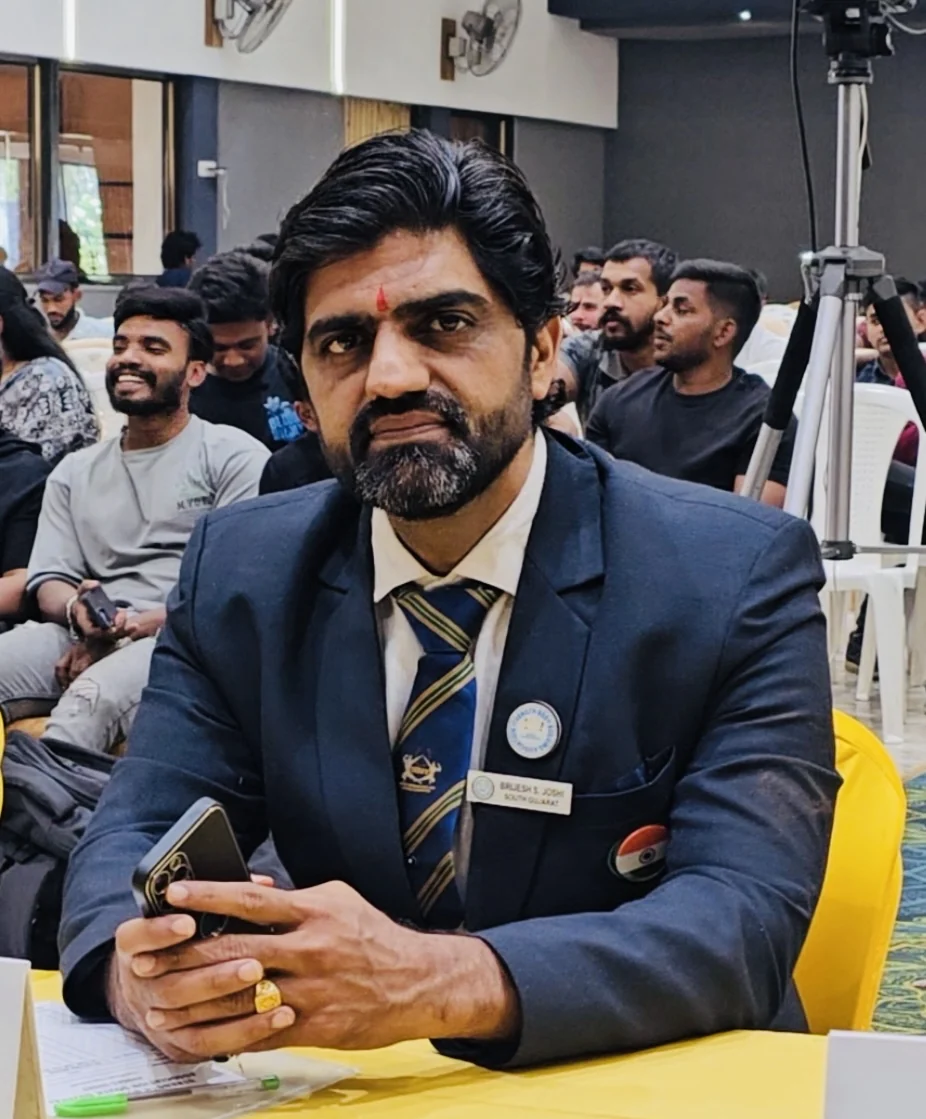
Written by Brijesh Joshi
Founder of S R Gym, Surat, coaching since 1999. President of the Strength Bodybuilding Association South Gujarat and a registered IBBFF judge. See credentials.
People in Surat searching for one place that does both usually end up with a list of yoga studios or a list of gyms and no answer to the question they actually asked. This page is that answer, including the part where I tell you what we do not offer.
There is no separate yoga class at S R Gym, no timetable to check and no second fee. I want to say that first, because it is the thing most people are expecting when they search and it would be easy to let the expectation stand.
What happens instead is that every session opens with yoga. A member arrives, and before touching a weight, does the twelve positions of Surya Namaskar and a short mobility sequence. Four to six rounds, three or four minutes. Then the strength work begins. That has been the rule here since 1999 and it applies to everyone, from a nineteen-year-old wanting to put on size to a member in their sixties.
The reason is straightforward. A good share of the people who walk in here have spent nine or ten hours sitting. Hips folded, upper back rounded, shoulders that have not been overhead all day. Loading a body in that state can leave the lower back quietly taking work that was never meant for it. A few minutes of moving every joint through its range first changes the body that arrives at the first set.
What an ordinary S R Gym membership includes where the yoga is concerned, set against the things this gym does not offer.
| What people ask about | Included in an ordinary membership | Not offered here |
|---|---|---|
| The yoga itself | The twelve positions of Surya Namaskar and a short mobility sequence at the start of every session, four to six rounds before the first set. | No separate yoga class, and nothing to book. |
| How it is taught | Taught to each new member during the first fortnight by Brijesh Joshi, who completed a foundation course in yoga science in 2014, then corrected on the floor for as long as you train here. | No group batch, and no instructor at the front of a room. |
| What it costs | Part of the membership, which starts at ₹1,700 for one month. The full fee page. | No cheaper rate for skipping the yoga, because it is not priced separately and cannot be dropped from a session. |
| When you can do it | Whenever you come in to train. Katargam opens at 5am and Adajan at 6am, both until 10pm, Monday to Saturday. | No fixed class hour, and nothing on Sunday, when both branches are closed. |
| What is sold alongside it | Coaching and the use of the floor. Personal training, where the whole session is programmed and supervised, is the one thing costed separately. | No supplements of any kind, and no coaching on anabolic steroid use. |
Brijesh Joshi has coached in Surat since 1999 and dates his own fitness journey to 1991. In 2014 he completed the Foundation Course in Yoga Science for Wellness at Surat's district yoga wellness centre, which runs under the aegis of the Morarji Desai National Institute of Yoga, an autonomous body under the Ministry of AYUSH — a one-month foundation course, which is where the yoga in these sessions comes from. Alongside it sit personal training certifications from GFFI and others, a special population training certificate for working with people who have additional medical considerations, and registration as a judge with the Indian Body Building and Fitness Federation. He is President of the Strength Bodybuilding Association South Gujarat.
The certificates are photographed and shown on the credentials page.
The relevant point for this page is narrower than the list. It is that the person teaching you the sequence is qualified in both things rather than a lifter working from a video he watched once, which is what I have often found sitting behind a gym that advertises yoga.
This is the question people actually want answered, and it has a clear answer.
Moving sequences before lifting. Surya Namaskar at a moderate pace is a warm-up. It raises body temperature and moves the joints, which is what you want in the ten minutes before a squat.
Long held stretches after lifting, or on a rest day. Holding a deep stretch for a minute or more immediately before heavy lifting can leave you feeling less stable under the bar. Afterwards, it is useful and pleasant.
A longer practice on one rest day. Twenty to thirty minutes once a week does more for your range of motion, as far as I have seen on this floor, than adding rounds to the warm-up ever will.
Keep lifting through a full range. Training through a complete range is itself mobility work. A deep squat done properly is both.
The longer version of this, with the twelve positions drawn out in order and the research set out honestly, is on the Surya Namaskar page.
Two recordings from his own channel: the short one on why these are not alternatives, and a complete twenty-five minute session you can follow at home before you ever visit.
Yoga or gym: the importance of both
Seven minutes, in Hindi, on why yoga and gym training belong together.
Twenty-five minutes of yoga
A full follow-along session recorded for World Yoga Day in 2020.
Some people get a great deal out of this arrangement, in my experience of running it since 1999, and some people are genuinely better served somewhere else. I would rather set out both halves than only the flattering one.
This is for you if
Look elsewhere if
I would rather you arrive with accurate expectations than impressive ones, so here is the honest position.
For long-standing, non-specific back pain, reviews comparing yoga against other back-focused exercise find little or no difference between them, and clinical guidelines including the American College of Physicians list yoga among the first non-drug options to consider. That is a real endorsement, and it is an endorsement of yoga as one reasonable option among several rather than as a superior treatment. Against doing no exercise at all, the measured improvements were smaller than the change a patient would notice as clearly different.
For flexibility, the clearest evidence is in older adults and shows improvement against not exercising, with a much smaller advantage over other active exercise. And starting yoga carries a small increase in temporary flare-ups of existing back pain, roughly four people in a hundred against one, which is no worse than other exercise but is not nothing.
None of that says yoga cures anything, and I will not say it either. What it supports is offering both, teaching the sequence properly, and letting you keep doing the thing you will actually keep doing. The full set of sources is listed here.
Membership starts at ₹1,700 for one month, with yoga included rather than charged separately. Personal training, where the whole session is programmed and supervised, starts at ₹7,000 for one month. The full fee page.
This page is general information from a coach who completed a yoga foundation course rather than from a yoga teacher, and it is not medical advice. If you have back pain that travels down a leg, numbness, weakness, or any change in bladder or bowel control, see a doctor rather than beginning an exercise routine.
Twenty minutes at the side of the floor will tell you more than this page can. Call +91 98790 69960, or message and say which branch suits you.
Free, no sign-up, and the arithmetic is explained on each page.