
S R Gym Adajan
3rd floor, above Way Wait Restaurant, near Deepa Complex, Krishna Nagar Society, Kalpana Society Part-2, Choksi Wadi,Adajan, Surat, Gujarat 395009
- Mon–Sat
- 06:00 am – 10:00 pm
- Sunday
- Closed
- Google rating
- 4.6 from 28 reviews
The short answer
Therapeutic exercise, which includes the gradually loaded strength work I coach at both branches, is recommended as a core treatment in mainstream clinical guidance for knee osteoarthritis and for pain around the kneecap, which are the two commonest reasons people come to me about a knee. Across pooled trials the average benefit is small to moderate, and it fades once the training stops, which is why I treat it as a habit rather than a course of treatment. I run a gym and I cannot diagnose anything, so anyone showing the warning signs listed on this page is sent to a doctor before I put them under a bar. Everything else here is about how the squat, the load and the pace get modified so you can keep training while the knee is sore.
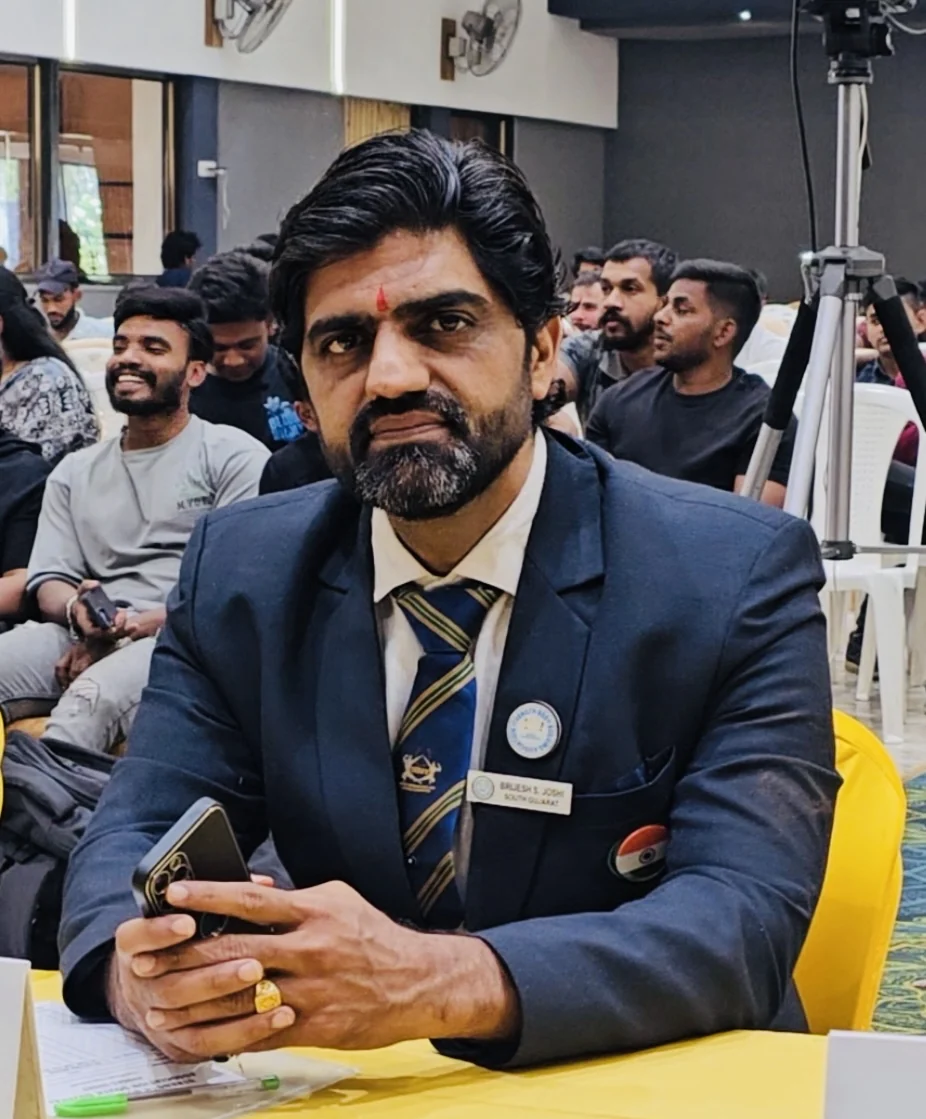
Written by Brijesh Joshi
Founder of S R Gym, Surat, coaching since 1999. President of the Strength Bodybuilding Association South Gujarat and a registered IBBFF judge. See credentials.
A large share of the people who walk into my gyms past the age of forty come in about a knee, and a good many of the rest come in about a back. The backs are covered on the back and posture training page, and this one is for knees, hips and joints that ache.
Start with what the guidance says, because it is stronger than most people expect. The NICE osteoarthritis guideline NG226, published in 2022, tells clinicians to offer therapeutic exercise to every person with osteoarthritis, and names exercise and weight management as the core treatments. That is mainstream clinical advice rather than something a gym owner invented to sell memberships.
The size of the benefit deserves stating honestly. A Cochrane review by Fransen and colleagues in 2015 pooled 44 trials and found exercise reduced knee pain by about 12 points out of 100 immediately after a programme, with function improving by about 10. At two to six months those figures had fallen to roughly 6 points and 3 points. That is a small to moderate average effect, it matters to a lot of people, and it fades once the training stops, which is why I treat this as something you keep doing rather than a course you finish.
For pain around and under the kneecap, the 2019 patellofemoral pain guideline in the Journal of Orthopaedic and Sports Physical Therapy gives exercise targeting both the hip and the knee its strongest grade of recommendation, and prefers that over knee work alone. This is why a member who arrives complaining about a knee spends a surprising amount of time working the hip.
Two things training will not do. It will not repair worn cartilage and it will not reverse arthritis, whatever the internet has told you. My own coaching judgement, formed on the floor since 1999 rather than from any trial, is that most people who stay with it end up doing considerably more with the same knee. The guidelines are careful about mechanism too, recommending the exercise while stopping short of claiming that stronger muscles around the joint are the reason it helps.
I run a gym and I am a coach. I do not diagnose anything, I do not treat anything, and I do not read scans. What I decide is whether the person in front of me should be training this morning or sitting in a doctor's waiting room, and I would far rather send ten people unnecessarily than miss the one who needed it.
The table below is how I make that call. The signs after an injury come from the Ottawa knee rules, a screening tool used in emergency departments, which are designed to catch nearly every fracture that matters at the cost of sending plenty of people for an X-ray who turn out to be fine. That is the correct direction to fail in.
| What you notice | Ordinary training soreness | See a doctor before your next session |
|---|---|---|
| Timing of the pain | Comes on some hours after a session and eases over 2 to 3 days | Pain at night or at complete rest, or pain that wakes you |
| Swelling | Nothing visible, or mild puffiness that settles within a day | The joint swells within hours, or feels hot and looks red |
| Morning stiffness | Loosens within 30 minutes of getting out of bed | Stiff well beyond 30 minutes, or several joints stiff and swollen at once |
| Weight bearing | Uncomfortable on stairs, and you can still walk normally | You cannot take 4 steps, or cannot bend the knee to 90 degrees, particularly after a fall |
| How it behaves | Grumbles at a predictable point in a movement and settles after | The knee locks, catches, or gives way underneath you |
| How it started | Built up gradually over weeks with no single incident | A specific fall, twist or blow, especially if you are 55 or over |
| The rest of you | You feel entirely well otherwise | Fever, feeling unwell, unexplained weight loss, or calf swelling, pain and warmth |
NICE describes the ordinary osteoarthritis picture as activity-related joint pain in somebody aged 45 or over, with morning stiffness that is either absent or gone within 30 minutes. Stiffness dragging on well past half an hour, or several hot swollen joints at the same time, points somewhere else entirely and belongs with a doctor rather than with me.
Usually yes, in some form, and almost never in the form you were doing before you came in. The belief that squatting wrecks knees has less behind it than its popularity suggests. A scoping review by Rojas-Jaramillo and colleagues in Frontiers in Sports and Active Living, 2024, found 13 of 15 studies supporting the safety of the deep squat for knee joint health, provided proper technique is maintained.
Read the limitations before carrying that further. Most of those interventions ran only 6 to 10 weeks, several carried a moderate to high risk of bias, and the people studied largely did not have painful knees. That weakens the case against the squat for healthy knees, and it gives me no permission to load depth on a member whose knee already hurts. What it does support is starting from the position that a squat of some kind probably belongs in your programme, and then finding out which one.
So the squat gets modified rather than banned. The order below is my own preference from coaching rather than anything a trial established.
Sharp pain at one specific point, a knee that gives way, or pain that climbs a little further every session means we stop that exercise and you get assessed.
An ache arriving some hours after a session, spread across the joint rather than sitting at one point, with no swelling, and settling within 2 to 3 days, is the ordinary response of a tissue asked to do more than it was used to. It is commonest in the first month and after any jump in load.
NICE says something here that I wish more people knew. NG226 tells clinicians to warn people that joint pain may increase when they start therapeutic exercise, and to explain that regular and consistent exercise will benefit their joints even though it may initially cause pain or discomfort. Being sore at the start is expected, and it is written into national guidance rather than being gym folklore.
Be careful how far you carry that. A review by Smith and colleagues in the British Journal of Sports Medicine, 2017, found painful exercise slightly ahead of pain-free exercise for short-term pain, with no difference in the medium or long term. When the question was revisited in the Journal of Orthopaedic and Sports Physical Therapy in 2025, the effect was unclear, and the only conclusion those authors would stand behind was that pain during exercise may not need to be avoided. Mild discomfort is a poor reason to stop, and there is no solid evidence that pain is doing you any good either.
A knee still sore beyond the fourth day, or hurting a little more after every session rather than a little less, tells me the load went up too fast. When a member says the pain arrives after training and never during it, my first move is to cut the volume by about a third and hold it there for a fortnight, which is a judgement formed on the floor rather than one I can cite a paper for.
For long-standing knee pain the guidance points towards staying active, and long spells of complete rest tend to leave you weaker while the discomfort stays much the same. The exceptions are real and I will name them plainly: a fresh injury, anything in the right hand column of the table above, and any rest your own doctor has told you to take. Relative rest, where the painful joint is left alone for a while and the rest of your body keeps training, is very often the right answer.
The evidence for staying active gets overstated constantly, so here it is with its limits attached. A meta-analysis by Alentorn-Geli and colleagues in the Journal of Orthopaedic and Sports Physical Therapy, 2017, pooled 17 studies covering more than 100,000 people and found hip or knee osteoarthritis in 3.5 per cent of recreational runners against 10.2 per cent of sedentary people, with competitive runners higher again at 13.3 per cent. That is observational data, and people whose knees already hurt give up running, so it cannot show that sitting still causes arthritis. It sits badly with the idea that ordinary recreational activity wears knees out, and that is as far as I would push it.
Cycling is a sensible choice and the evidence for it is narrower than the internet suggests. A systematic review by Luan and colleagues in Clinical Rehabilitation, 2021, covering 11 studies and 724 participants, found stationary cycling reduced pain against no exercise by a weighted mean difference of about 13 points out of 100. Improvements in stiffness, daily activity, symptoms and quality of life did not reach the level considered clinically important. So use the bike for pain and conditioning, keep the resistance moderate, and get your strength from actual strength work.
On body weight I lead with the useful figure instead of the dramatic one. NICE advises that any amount of weight loss is likely to help, and that losing 10 per cent of body weight is likely to be better than losing 5 per cent. The number quoted everywhere else, that each kilogram lost takes roughly 40 newtons of compressive force off the knee with every step, comes from Messier and colleagues in Arthritis and Rheumatism, 2005, and it was measured in sedentary adults aged 60 to 89 who were overweight or obese and already had knee osteoarthritis. It describes joint load rather than pain, and it says nothing useful about a lean member with a sore knee.
A community study by Pal and colleagues in the Indian Journal of Orthopaedics, 2016, covering 5,000 people across five sites, put knee osteoarthritis at 28.7 per cent overall and 31.6 per cent among women, associated with age, obesity and sedentary work. That last association is what I think about when a member tells me he sits for eleven hours a day. Different regions and methods produce quite different numbers, so read it as one careful study rather than a figure for Surat.
A gym that greets an aching knee with a lecture about the weighing scale has it backwards. We start with strength and with getting you moving comfortably, and if losing weight belongs in your plan it comes up later as its own piece of work, which is what fat loss coaching is for.
Every session at both branches opens with yoga and the twelve positions of Surya Namaskar before anybody touches a weight, and that has been the house rule since I opened in 1999. For a stiff knee it buys a few minutes of controlled movement through the hips, ankles and knees before load arrives, and it tells me how the joint is behaving that morning. The honest version of what the research does and does not show is in my longer guide on Surya Namaskar before weight training.
After that the shape of the work is deliberately unremarkable.
I hold an advance fitness personal trainer certificate and a special population training certificate, both from Dr Mahesh Kumar's Medical Institute, and both are photographed on the credentials page. Neither of them makes me a clinician. My yoga training is a one-month foundation course at Surat's district yoga wellness centre, scanned and on that page too, and it is where the mobility work in these sessions comes from.
Members arriving with sore joints are usually better served by personal training than by a floor membership for the first few months, because somebody has to watch the joint under load. Much of this sits inside the wider picture on training after 40.
This compares two kinds of gym rather than two businesses, and I am not going to name anybody in Surat. A budget chain membership is a sensible purchase for somebody who already knows how to train and how to change what they are doing when a joint complains. The difficulty arrives when you do not, because the equipment is set up for an average person and your knee is a specific one.
| When your knee hurts | A large budget chain | A coached gym like this one |
|---|---|---|
| Your first session | A standard induction around the machines, the same one everybody gets | A conversation about the joint, what a doctor has said, and what we leave out for now |
| Choosing how to squat | The rack and the machines are available and the depth and load are your own problem | Depth, variation and load chosen for the knee you walked in with and reviewed weekly |
| When it hurts more | Usually nobody is watching closely enough to notice it happening | Somebody notices, the load comes down that day, and the session carries on around it |
| Warning signs | Nothing in the process is designed to catch them | You are asked about them at the desk and sent to a doctor when they appear |
| How you progress | You decide it yourself, or an application on your phone decides for you | Small planned increases that get held whenever the joint objects |
| What it costs | A low monthly fee with no coaching attached to it | ₹1,700 for one month on the floor, or ₹7,000 for one month coached one to one |
If your joints are fine and you know what you are doing, the cheaper option is a good one and I am happy to say so out loud. Once a painful joint is involved, the thing you are paying for is somebody watching it. The same comparison is worked through in full on a coached gym against a budget gym, and there is a longer piece on how to choose a gym in Surat if you want the full set of questions to ask.
Membership starts at ₹1,700 for one month. For most people arriving with a painful joint, personal training is the better place to begin, since every session is supervised. That starts at ₹7,000 for one month, and the whole fee list is on the membership fees page. I read the joint myself before anybody is programmed, so the person assessing your knee is the person who wrote this page.
Every effect size here is given as the research reported it, including where the number is smaller than a reader would hope. Nothing on this page is a treatment claim, and none of it can tell you anything about your own knee.
Osteoarthritis in over 16s: diagnosis and management (NG226)
National Institute for Health and Care Excellence, 2022 · Clinical guideline
Recommends offering therapeutic exercise to all people with osteoarthritis, names therapeutic exercise and weight management as the core treatments, warns that joint pain may increase when exercise starts, and advises that losing 10 per cent of body weight is likely to be better than losing 5 per cent.
Exercise for osteoarthritis of the knee
Cochrane Database of Systematic Reviews, 2015 · Systematic review, 44 trials
Exercise reduced pain by 12 points out of 100 immediately after treatment and by 6 points at two to six month follow-up. Physical function improved by 10 points, falling to 3 points at follow-up. The average effect is a small to moderate one and it decays without continued training.
Patellofemoral Pain: Clinical Practice Guideline
Journal of Orthopaedic & Sports Physical Therapy, 2019 · Clinical practice guideline
Gives exercise targeting both the hip and the knee the strongest grade of recommendation for pain at the front of the knee, and prefers combined hip and knee work over knee-focused work alone.
Should exercises be painful in the management of chronic musculoskeletal pain?
British Journal of Sports Medicine, 2017 · Systematic review and meta-analysis, 7 trials
Painful exercise was slightly ahead of pain-free exercise for short-term pain, standardised mean difference 0.27, with no difference at medium or long term and no difference in function at any point.
Effectiveness of Painful Versus Nonpainful Exercise
Journal of Orthopaedic & Sports Physical Therapy, 2025 · Updated systematic review
Revisiting the same question with searches to May 2024, the effect on patient-reported outcomes was unclear. The conclusion the authors would stand behind is only that pain during exercise may not need to be avoided.
Impact of the deep squat on articular knee joint structures, friend or enemy?
Frontiers in Sports and Active Living, 2024 · Scoping review, 15 studies
13 of 15 studies supported the safety of the deep squat for knee joint health where proper technique is maintained. Most interventions ran 6 to 10 weeks, several carried a moderate to high risk of bias, and the participants largely did not have painful knees.
Stationary cycling exercise for knee osteoarthritis
Clinical Rehabilitation, 2021 · Systematic review and meta-analysis, 724 participants
Cycling reduced pain against no exercise by a weighted mean difference of 12.86 points. Improvements in stiffness, daily activity, symptoms and quality of life did not exceed the minimal clinically important difference for those outcomes.
Weight loss reduces knee-joint loads in overweight and obese older adults with knee osteoarthritis
Arthritis & Rheumatism, 2005 · Biomechanical analysis within an 18 month trial, 142 adults
Each kilogram of body mass lost was associated with roughly 40 newtons less knee compressive force per step. This was measured in sedentary adults aged 60 to 89 who were overweight or obese and already had knee osteoarthritis, and it describes joint load rather than pain.
The Association of Recreational and Competitive Running With Hip and Knee Osteoarthritis
Journal of Orthopaedic & Sports Physical Therapy, 2017 · Meta-analysis, 17 studies, over 100,000 people
Hip or knee osteoarthritis appeared in 3.5 per cent of recreational runners, 10.2 per cent of sedentary controls and 13.3 per cent of competitive runners. Observational data carrying obvious selection bias, since people whose knees hurt tend to stop running.
Epidemiology of knee osteoarthritis in India and related factors
Indian Journal of Orthopaedics, 2016 · Community-based study, 5,000 people across 5 sites
Knee osteoarthritis prevalence was 28.7 per cent overall and 31.6 per cent among women, associated with age, obesity and sedentary work. One careful study rather than a national figure, and not a figure for Surat.
This page is general information written by a fitness coach, and it is not medical advice. S R Gym is a gym rather than a medical provider, and we do not diagnose or treat anything. If a joint is painful, particularly with any of the signs listed in the table above, speak to a doctor or a physiotherapist first. Written and last reviewed by Brijesh Joshi on 7 September 2026.
If you have already been assessed, tell me what you were told and the programme gets built around it. If you have not, I will say so honestly before you pay anything. You can reach me on +91 98790 69960.