
S R Gym Adajan
3rd floor, above Way Wait Restaurant, near Deepa Complex, Krishna Nagar Society, Kalpana Society Part-2, Choksi Wadi,Adajan, Surat, Gujarat 395009
- Mon–Sat
- 06:00 am – 10:00 pm
- Sunday
- Closed
- Google rating
- 4.6 from 28 reviews
The short answer
When your physiotherapist discharges you, the job changes from settling symptoms to rebuilding the capacity you lost, and those are two different jobs. I take the restrictions your physiotherapist has given you, train everything that sits outside them, and rebuild the injured pattern slowly inside them, so that I am working to their instructions rather than around them. I am a coach and I am not a clinician, which means I will not diagnose anything, I will not overrule a physiotherapist, and I will send you back to them the moment your symptoms change direction. In practice a return starts well below what you could lift, it is judged by how you feel the next morning, and load goes up only when the week before it has settled.
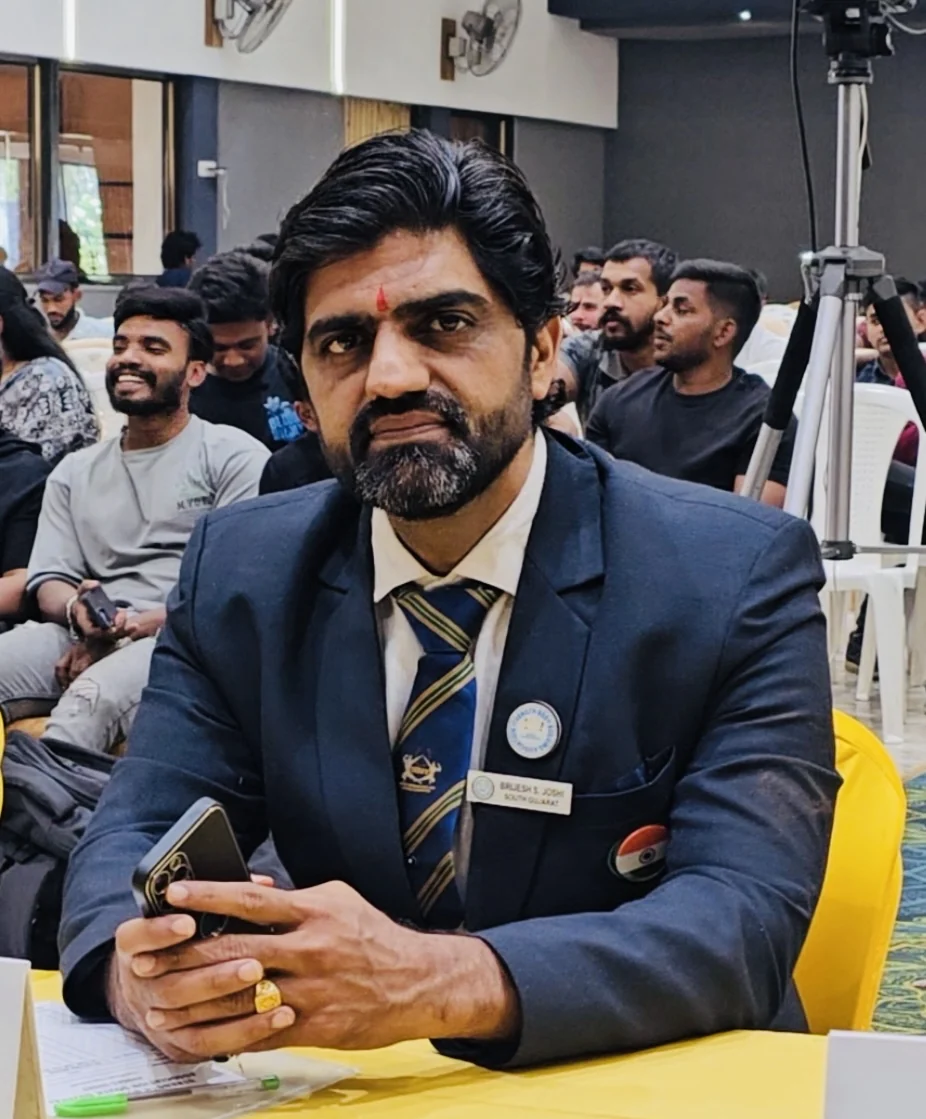
Written by Brijesh Joshi
Founder of S R Gym, Surat, coaching since 1999. President of the Strength Bodybuilding Association South Gujarat and a registered IBBFF judge. See credentials.
The commonest version of this conversation at my gym starts with somebody standing at the desk holding a physiotherapy discharge slip and saying that they have been told they can exercise now, without anybody telling them what exercise means. I have been coaching in Surat since 1999 and this handover is the part of the process I see covered least well, so this page sets out exactly how I handle it, where my job ends and where a clinician's job begins.
Rehabilitation settles symptoms and restores the movement you lost, and it belongs to a physiotherapist who has examined you. Training rebuilds the capacity to take load again in ordinary life, and that part is my job. The weeks straight after discharge are where I see this go wrong, and the pattern is usually the same. Somebody finishes rehabilitation feeling fine at rehabilitation loads, walks into a gym, and meets loads several times larger within a fortnight.
The 2016 Bern consensus statement in the British Journal of Sports Medicine described return to sport as a continuum rather than a single decision taken at the end of rehabilitation. A 2014 review in the same journal, pooling 69 studies and 7,556 people after knee ligament reconstruction, found 81 per cent returned to some sport and 55 per cent to competitive sport. Both concern athletes after specific injuries and neither transfers to a member with a disc problem. What they tell me is that finishing formal rehabilitation starts a stage rather than ending the story.
One more thing is worth saying plainly, and it concerns qualifications rather than modesty. Physiotherapy in India is a regulated profession, and the National Commission for Allied and Healthcare Professions Act of 2021 provides for a statutory register of practitioners, while personal trainers have no equivalent register of any kind. My certificates are real and every one is scanned on my credentials page, and none of them makes me a clinician. Your physiotherapist outranks me on anything to do with your injury, and I run the programme accordingly.
This page invites people with back problems to train, so it has to carry the warning signs too. Go to a hospital emergency department the same day, without waiting for an appointment with anybody, if you develop any of the following.
Those symptoms can be a sign of cauda equina syndrome, which is a surgical emergency where delay can cause permanent damage. It is rare, it has other possible causes, and it is serious enough that any page telling people with disc symptoms to lift weights ought to name it and let a hospital rule it out. Milder things, such as an ache after a session or a leg symptom returning gently, are a reason to message me and to speak to your physiotherapist.
My rule is that I work from the restrictions rather than around them. If a physiotherapist has said no loaded spinal flexion for now, then loaded spinal flexion is off the programme until that same physiotherapist says otherwise, and I will not go hunting for a clever variation that avoids the wording while doing the same thing to your back. A restriction is a boundary drawn by somebody who examined you, and the useful response is to build everything else to a good standard while it holds.
In practice a lot of discharge advice here is given verbally at the end of the last session and nothing goes home on paper. When somebody arrives with nothing written down, I write out the questions and ask you to send them to your physiotherapist on WhatsApp, or I offer to speak to them directly if you give me permission and a number. Until an answer comes back, I train the areas that were never in question and keep the injured area so light that nothing can be provoked.
The questions are short and specific. Which movements are restricted and for how long. How much range you are cleared to work through at the injured joint. Whether any weight limit applies, and what should make you stop and come back for review. Any physiotherapist can answer those in a couple of lines, and those lines are what the programme is built on.
There are no weeks in this table and that is deliberate. A phase ends when you meet the condition in the last column, which might take a fortnight or three months depending on the injury and the person. In the Delaware-Oslo cohort study, published in the British Journal of Sports Medicine in 2016, athletes who passed strength and hop testing before returning were reinjured less often, 5.6 per cent against 38.2 per cent, although that particular comparison did not reach statistical significance on its own with a p value of 0.075. The finding that held up was that each further month of delay, up to nine months, was associated with a 51 per cent lower reinjury rate. Those were pivoting athletes after knee ligament reconstruction rather than gym members, and the principle I take from it is that a criterion beats a calendar.
| Phase | You enter when | What changes | You leave when |
|---|---|---|---|
| 1. Handover | Your physiotherapist has discharged you and the restrictions are written down | Nothing is loaded yet. I screen your movement against the restriction list and we agree the programme | You and I can both state what is off the list and why it is off |
| 2. Re-loading | The restrictions are understood and written on the programme itself | The pattern is re-taught at loads well under what you could manage, and both sides are trained | You control the full range your physiotherapist cleared, and symptoms settle by the next morning |
| 3. Rebuilding | Symptoms have been steady from one week to the next | Load goes up in small steps, and the injured side is measured against the other side | The gap between the two sides closes to the standard your physiotherapist set |
| 4. Normal training | The gap has closed and nothing has flared through a full block of training | You run the ordinary programme, and I keep tracking the injured pattern quietly in the background | It has stopped being a special case and has become plain training |
Plenty of pages will tell you to add ten per cent a week. That rule was tested in a randomised trial of 532 novice runners published in the American Journal of Sports Medicine in 2008, where the graded programme built on it produced an injury rate of 20.8 per cent against 20.3 per cent for the ordinary programme, with a p value of 0.90. The acute to chronic workload ratio, the other rule people quote at me, was reassessed in Sports Medicine in 2021 by authors who argued it should be set aside as a framework. I have no weekly percentage to give you, and saying so is more useful than inventing one.
What I use instead is a monitoring rule borrowed from tendon research. Silbernagel and colleagues, writing in the American Journal of Sports Medicine in 2007, kept patients training under three conditions, pain no higher than 5 out of 10 during the activity, symptoms settled by the following morning, and symptoms not creeping upwards week on week. Those patients did as well as the patients who were given six weeks of rest, in a trial of 38 people with Achilles tendinopathy that is far too small to prove the two approaches are equivalent. It has not been validated for discs, shoulders or operations either, so I offer it as the way I watch load rather than as a medical threshold that applies to you.
Most people arrive asking about pain-free range, and the research is less tidy than the phrase suggests. A 2017 review in the British Journal of Sports Medicine pooled nine papers covering 385 people and found that protocols permitting pain gave a small short-term advantage, with no significant difference in the medium or long term. That population had chronic musculoskeletal pain and the sample was small, so it gives nobody permission to push into pain after a fresh injury or an operation. The working version I give members is that discomfort during a rehabilitation exercise is not automatically damage, while the range your physiotherapist cleared remains the boundary.
In the room this looks unremarkable. We pick a load you could manage for twice the repetitions asked, finish every set with something left, and compare the next morning with the morning before. Three sessions in a row that pass earn a small increase, and a worse morning means the load comes down and stays there. It is the approach I use with beginners in their first 90 days in the gym, run more slowly.
Slip disc is the phrase almost everybody uses in Surat, and it usually means a bulging, protruding or herniated lumbar disc found on an MRI. A 2015 systematic review in Clinical Rehabilitation covering 31 studies found spontaneous regression on imaging in 96 per cent of sequestrated discs, 70 per cent of extrusions, 41 per cent of protrusions and 13 per cent of bulges. That describes a disc changing on a scan rather than a person's symptoms changing, and the review makes no claim that exercise causes the change. The fair reading is that many herniations shrink on their own over time, which is part of why conservative management is usually tried before surgery.
What goes on the programme starts with movements where the spine holds one position while something else works. Loaded carries at a manageable weight, chest-supported rows, split squats, leg press within a cleared range and slow controlled machine work come first. The trunk is trained by resisting movement through carries and holds, since resisting movement is most of what the muscles around the spine do in ordinary life. Hip hinging is taught again from the beginning with a dowel or an empty bar, because a hinge you can trust is, in my judgement, worth rebuilding before anything heavy goes near the floor.
What returns last, and for some people never returns, is heavy loading of a rounding lower back under fatigue. Heavy deadlifts from the floor, weighted sit-ups and any lift whose last repetitions turn ugly sit at the end of the queue. That ordering is my own coaching judgement from watching members recover since 1999 rather than a finding I can point to in a paper. The full explanation of how I sequence a programme is on the S R Gym method page, and anybody whose back trouble comes from desk work with no diagnosis behind it is better served by back and posture training.
Every session at both branches opens with yoga and the twelve positions of Surya Namaskar before anybody touches a weight, which has been the house rule since 1999. After a disc problem I modify the sequence instead of skipping it, since several positions involve exactly the spinal flexion and extension that may be restricted for you, and I swap those for alternatives until your physiotherapist clears the full round. The reasoning is set out in the guide to Surya Namaskar before weight training. One member, Ashutosh Banerjee, who trains at Adajan from 8 to 9am, told me in September 2026 that he had gone three months without the neck and back pain he used to get, crediting the daily Surya Namaskar for the flexibility. That is one person's account of his own experience, and it is not evidence that this reliably works for anybody else.
Shoulders follow the same logic with different movements. In most cases you can train legs, the trunk and the uninjured arm from the first session, once your physiotherapist is happy with that, which keeps the habit alive and holds on to a good deal of your fitness while one joint recovers. For the shoulder itself I work inside the range your physiotherapist cleared, starting below shoulder height, adding rotation work under light resistance, and leaving overhead pressing until last because it asks for the most range under the most load.
One trial changed how a lot of coaches think about common shoulder pain. The CSAW trial in The Lancet in 2018 randomised 313 patients with subacromial shoulder pain to decompression surgery, placebo surgery or no treatment, and the Oxford Shoulder Score at six months was 32.7 after real surgery against 34.2 after placebo surgery, a difference of minus 1.3 with a p value of 0.31. That covers one operation for one shoulder diagnosis, it is no evidence that exercise beats surgery in general, and nobody should use it to decline an operation they have been advised to have. What it supports is the ordinary sequence in which careful loading is tried before anything more invasive is considered.
This is a category comparison and I am not going to name another gym in Surat. A budget chain suits a healthy person who already knows how to train, since you get long hours, plenty of equipment and a low monthly price, with floor staff usually spread across a large number of members. After an injury, the thing you most need is the thing that model can least provide, which is somebody who has read your discharge advice, knows which movements are restricted, and notices in week three that you have quietly started rounding your back again on the last set.
A coached gym costs more each month and offers fewer machines. It gives you one coach holding the whole picture, a programme written down with your restrictions at the top of it, and somebody watching the sets rather than watching the room. For a person coming back from a disc or a shoulder problem, I think that supervision is the part worth paying for. If the price difference matters, take coached sessions for the first stretch while the pattern is rebuilt and decide afterwards, and you can see how both are priced on the membership fees page or compare the wider market on what gyms in Surat charge.
Membership starts at ₹1,700 for one month. For anybody coming back from an injury I recommend personal training, because it means every session is supervised by me and the programme is written around your restrictions rather than around a general plan. That starts at ₹7,000 for one month. Both branches are run by me, Brijesh Joshi, and you can check the full opening times before you visit.
Every study below is described with what it actually found and with the population it was run in, including where that population is nothing like a gym member in Surat. Where a claim on this page is my own coaching judgement instead, I have said so in the same sentence.
British Journal of Sports Medicine, 2016 · Expert consensus statement
The panel described return to sport as a continuum running through return to participation, return to sport and return to performance, and stated that it is not a decision taken in isolation at the end of rehabilitation. That is the clearest published support for treating the handover from physiotherapy to training as part of the process rather than as an afterthought.
British Journal of Sports Medicine, 2014 · Systematic review and meta-analysis, 69 studies, 7,556 people
81 per cent returned to some sport, 65 per cent to their pre-injury level and 55 per cent to competitive sport. This is ACL reconstruction in athletes and it says nothing directly about discs, shoulders or ordinary gym members, so read it as an illustration that finishing formal rehabilitation is not the same thing as being back.
British Journal of Sports Medicine, 2016 · Prospective cohort study, 106 athletes followed for 24 months
Athletes who passed strength and hop testing before returning were reinjured less often, 5.6 per cent against 38.2 per cent, although that particular comparison did not reach statistical significance on its own with a p value of 0.075. The robust finding was that each month return was delayed up to nine months was associated with a 51 per cent lower reinjury rate. The population is pivoting athletes after ACL reconstruction only.
American Journal of Sports Medicine, 2008 · Randomised controlled trial, 532 runners
A 13 week programme built on the ten per cent rule produced an injury rate of 20.8 per cent against 20.3 per cent for the standard programme, with a p value of 0.90. The ten per cent rule failed the one large trial that tested it, which is why I will not quote a weekly percentage to anybody coming back from an injury.
British Journal of Sports Medicine, 2017 · Systematic review and meta-analysis, 9 papers, 385 participants
Protocols that allowed pain during exercise gave a small short-term advantage, a standardised mean difference of minus 0.27, with no significant difference at medium or long term and none for function or disability at any point. The population was chronic musculoskeletal pain and the pooled sample was small, so this does not license pushing into pain after a recent injury or an operation.
American Journal of Sports Medicine, 2007 · Randomised controlled study, 38 patients
Patients who kept loading under a monitoring rule, pain up to 5 out of 10 during activity, settling by the next morning and not rising week on week, did as well as patients given six weeks of rest, with no difference detected between the groups. The study covered Achilles tendinopathy in 38 people, which is far too small a trial to establish that the two approaches are equivalent, and it has not been validated for discs, shoulders or post-surgical cases, so I use the rule as a monitoring habit rather than as a medical threshold.
The probability of spontaneous regression of lumbar herniated disc: a systematic review
Clinical Rehabilitation, 2015 · Systematic review of 31 studies
Spontaneous regression on imaging was reported in 96 per cent of sequestrated discs, 70 per cent of extrusions, 41 per cent of protrusions and 13 per cent of bulges. This describes the disc changing on a scan rather than a person's symptoms changing, and the review makes no claim that exercise causes it, so the fair reading is that many herniations shrink on their own over time, which is part of why conservative management is usually tried first.
The Lancet, 2018 · Multicentre randomised controlled trial, 313 patients
Oxford Shoulder Score at six months was 32.7 after decompression against 34.2 after placebo surgery, a mean difference of minus 1.3 with a p value of 0.31. This covers one operation for one shoulder diagnosis and it is not evidence that exercise beats surgery in general, so nobody should read it as a reason to decline an operation they have been advised to have.
This page is general information written by a fitness coach who holds a special population training certificate and a functional training qualification, both listed with their scans on the credentials page. It is not medical advice, it cannot tell you anything about your own injury, and it is no substitute for the physiotherapist or doctor who has examined you.
Message me with your discharge advice, your scan report if you have one and the restrictions you were given, and I will tell you honestly whether this is the right time to start. You can also call +91 98790 69960 and speak to me directly, or read more on the contact page.