
S R Gym Adajan
3rd floor, above Way Wait Restaurant, near Deepa Complex, Krishna Nagar Society, Kalpana Society Part-2, Choksi Wadi,Adajan, Surat, Gujarat 395009
- Mon–Sat
- 06:00 am – 10:00 pm
- Sunday
- Closed
- Google rating
- 4.6 from 28 reviews
The short answer
Students train at both S R Gym branches on the ordinary membership, which starts at ₹1,700 for one month, and there is no separate student rate. Katargam opens at 5:00 am and Adajan at 6:00 am, so a session can be finished before the first lecture of the day, and in my experience that is what separates a student membership that lasts from one that quietly stops in week five. Every session at both branches starts with yoga and the twelve positions of Surya Namaskar before anybody picks up a weight, and I have run it that way since 1999. I am a registered IBBFF judge and President of the Strength Bodybuilding Association South Gujarat, and I do not coach anabolic steroid use at any level, which matters more for a nineteen year old than for anyone else I train.
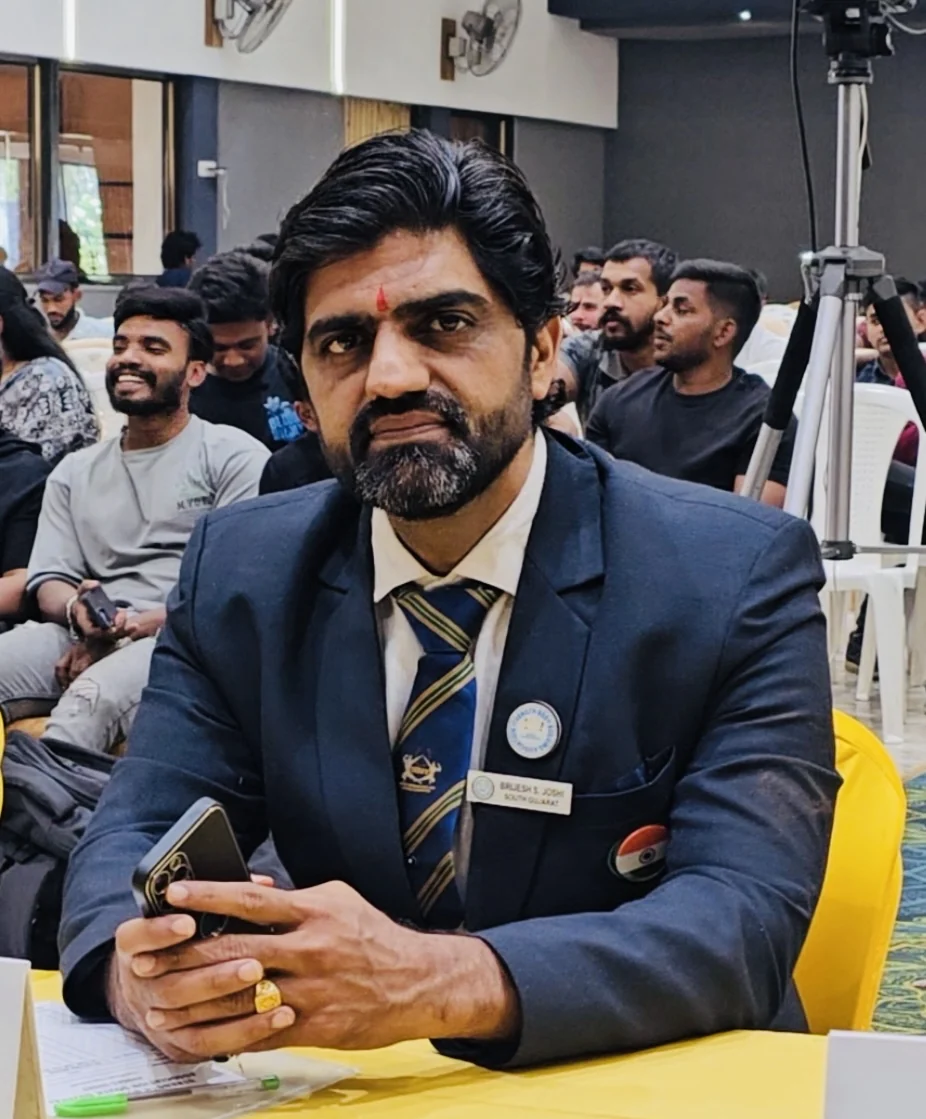
Written by Brijesh Joshi
Founder of S R Gym, Surat, coaching since 1999. President of the Strength Bodybuilding Association South Gujarat and a registered IBBFF judge. See credentials.
A student membership here is the same membership everybody else pays, at the same price, at either branch. What is worth more than a discount is an opening time early enough to beat a class timetable, and a coach on the floor watching the set you are doing. I have run S R Gym since 1999 and I coach at both branches myself, so when I say somebody is watching your first squat, I mean me.
I would rather you read the second list and decide this is the wrong gym than join, pay for three months and stop coming in week four.
Membership starts at ₹1,700 for one month, which is roughly 1,667 rupees a month. Four sessions a week across those three months is about 52 sessions, so you pay somewhere near 96 rupees for each session you attend, and the arithmetic gets worse every week you skip. Personal training, one to one with me, starts at ₹10,000 for one month, and most students do not need it, because the ordinary membership already puts you on a floor where I am correcting people.
I am not going to print what other gyms in Surat charge, because the monthly figures on directory sites are scraped, stale and occasionally invented. My own numbers sit on the membership fees page, with the wider picture on gym fees in Surat.
One cost this gym removes rather than adds is supplements, because we sell none of any kind at either branch. Nobody here earns anything from telling a student to buy a tub, which is worth knowing alongside what I have written about protein for Indian vegetarians.
S R Gym Katargam opens at 5:00 am and S R Gym Adajan at 6:00 am, both closing at 10:00 pm from Monday to Saturday and both closed on Sunday. The hours are set out branch by branch on the timings page.
The 5:00 am opening at Katargam is the most useful thing this gym owns for a student, and it is a scheduling advantage. A session that starts at five and finishes at quarter past six survives a lab running late, a viva that moves, and a friend deciding at seven in the evening that everyone is going out.
What I will not tell you is that the morning is physiologically superior. Grgic and colleagues reviewed the time-of-day training research in Chronobiology International in 2019 and reported strength gains broadly similar whether people trained in the morning or the evening. So train at the hour you can defend every week, since that review found no clear strength advantage either way. My own reason for pushing students early is that the evening floor is busiest between seven and nine, while at five and six I can stand beside you and fix the same mistake three sessions running.
This is the week I give most college students in their first three months, built around four sessions and the 5:00 am opening at Katargam. The last column is what I cut it to during an exam fortnight, because a plan with no exam version gets abandoned in December and never restarted.
| Day | Time at Katargam | Normal week | Exam fortnight |
|---|---|---|---|
| Monday | 5:00 to 6:15 am | Surya Namaskar, then legs and hips | Surya Namaskar, then 30 minutes of light full body |
| Tuesday | 5:00 to 6:15 am | Surya Namaskar, then chest and shoulders | Rest, with a 20 minute walk |
| Wednesday | Rest day | A 30 minute walk and stretching at home | Rest, with a 20 minute walk |
| Thursday | 5:00 to 6:15 am | Surya Namaskar, then back and arms | Surya Namaskar, then 30 minutes of light full body |
| Friday | 5:00 to 6:15 am | Surya Namaskar, then full body and core | Rest, with a 20 minute walk |
| Saturday | 7:00 to 8:30 am | Surya Namaskar, then whatever the week missed | Surya Namaskar on its own, 25 minutes |
| Sunday | Closed at both branches | Sleep properly, eat properly, plan the coming week | Sleep, study, and a walk in the evening |
At Adajan the same week starts an hour later. Every session begins with yoga and the twelve positions of Surya Namaskar, and if you have never trained before, read the first 90 days in the gym first.
Students ask whether training will cost them marks, and I have no study on this page that settles the question, so I am going to answer it as coaching judgement and label it as that. Since 1999 I have not watched three or four sessions a week pull anybody's results down, and a good number of students have told me the training hour is what lets them sit down with a book afterwards. That is what they report about themselves and I pass it on as exactly that. What I will not tell you is that the gym raises your percentage.
The American Academy of Sleep Medicine consensus, endorsed by the American Academy of Pediatrics, recommends 8 to 10 hours of sleep per 24 hours for teenagers aged 13 to 18, and that is the number I hold students to. The muscle side of the argument is weaker than the fitness industry pretends. Lamon and colleagues, in Physiological Reports in 2021, put 13 participants through one night of total sleep deprivation and measured muscle protein synthesis about 18 per cent lower and testosterone about 24 per cent lower. The sample was tiny, total deprivation is a long way from the five or six hours a student actually gets, and it measures a marker over hours instead of muscle over months. My own view, from coaching since 1999 rather than from any study, is that the student who sleeps five hours and trains six days is the one who turns up injured in week seven.
Most of the thin nineteen year olds who walk in here believe they have a fast metabolism, and almost all of them are eating far less than they think. Weight goes on when the day's total is above what you burn, and strength training influences how much of that ends up as muscle rather than as fat, which is set out on muscle gain coaching.
On protein the evidence is reasonably settled, and it saves students money. Morton and colleagues pooled 49 studies and 1,863 participants in the British Journal of Sports Medicine in 2018 and found the benefit from additional protein plateaus at roughly 1.62 g per kilogram of bodyweight a day, which is about 97 g for a 60 kg student. Dal, milk, curd, eggs, paneer, soya chunks and peanuts will carry you there, and a Gujarati kitchen is better set up for it than most students realise.
The next part is my judgement rather than a research finding, and I want that said in the same sentence. There is no peer-reviewed figure for a safe rate of muscle gain, and anybody quoting you kilograms per month is quoting a blog. The pattern I have watched for years runs like this. A young man fixes on a target size and a deadline, adds weight to the bar faster than his technique can hold it, hurts a shoulder, loses two months, and comes back disheartened enough to listen to whoever offers a shortcut.
I judge bodybuilding competitions myself, which is the reason this section carries any weight at all. I hold a Category B judge registration with the IBBFF, issued on 30 April 2024, I held a Gujarat State Bodybuilders Association judges card, number 0010, from 2019 until it lapsed in 2024, and I am President of the Strength Bodybuilding Association South Gujarat for 2025. All of it is photographed and dated on the credentials page. I sit on the panel at the competitions young lifters here are aiming at, and I still refuse to coach drug use at any level.
Let me be accurate about how common this is. Sagoe and colleagues pooled 187 studies in Annals of Epidemiology in 2014 and put global lifetime use at about 3.3 per cent, with Asia lowest of all regions at 0.2 per cent. Inside competitive bodybuilding circles the picture changes, and a 2020 study in the International Journal of Preventive Medicine found use common among the 84 bodybuilders it reached in an eastern Indian city. It recruited through other users, so it is not a prevalence rate for Indian gym goers and I will not present it as one. What I recognise in it is the finding that coaches are a major influence on whether a young lifter starts.
On harm I will put it the way the study I trust most puts it. Baggish and colleagues, in Circulation in 2017, compared 86 long-term users with 54 non-users among male weightlifters. Ejection fraction, a measure of how well the heart pumps, averaged 52 per cent in users against 63 per cent in non-users, and coronary plaque volume rose with each decade of use. The design was cross-sectional and the authors were open that how this translates into long-term outcomes such as mortality remains unsettled.
Coming off is the part nobody at a college gym mentions. A 2023 scoping review in Endocrine Connections found that hormonal recovery after stopping varies enormously from one person to the next, and that a substantial minority of former users still show low testosterone years afterwards. Recovery is usually partial to full, on a timeline nobody can promise you in advance. These substances also sit under Schedule H of the Drugs and Cosmetics Act 1940, which makes them prescription-only. The longer version is in steroids and bodybuilding in India.
This is the question a parent asks, and it is the one place on this page where the major position statements say the same thing. The American Academy of Pediatrics clinical report in Pediatrics in 2020 lists stunted growth as a myth, noting that no well-controlled prospective study has shown damage to growth cartilage from a supervised programme, and the 2014 international consensus in the British Journal of Sports Medicine agrees.
Both statements attach one condition and I want to be strict about it, because the condition is the whole answer. Safety depends on qualified supervision and sensible progression, and injuries in the literature cluster in unsupervised settings and with loads too heavy for the person lifting them. I coach at both of these branches myself and I am on the floor, so a school-age member here trains inside my line of sight and does not test a maximum in his first month. If you are under 18, bring a parent to the first conversation and ring me on +91 98790 69960 beforehand.
Play the sport and lift as well, because the real question is placement. In season I would give a college cricketer, kabaddi player or footballer two strength sessions a week and keep heavy leg work away from the two days before a match, and out of season that moves up to four sessions with the loads rising to match. That is coaching judgement, labelled as judgement because I have no study that settles the schedule for your sport.
What I ask sportspeople to protect is the Surya Namaskar at the start of every session, because they arrive with the tightest hips and shoulders of anybody I coach. Ashutosh Banerjee, who trains at Adajan from 8 to 9 in the morning, told me in September 2026 that he had gone three months without the neck and back pain he used to live with, crediting the daily Surya Namaskar. That is one person's account of his own experience and I pass it on as exactly that, with more accounts on the transformations page.
This comparison is written at category level and names nobody, because running down other gyms in Surat by name is beneath the trade. Read the middle column honestly, since for some students it is the right answer.
| What you are comparing | A budget or low-cost floor | A coached gym like this one |
|---|---|---|
| Price | Usually the lowest number available, which is a genuine advantage on a student budget | ₹1,700 for one month, roughly 1,667 rupees a month, one price for everybody |
| Equipment and comfort | Often more machines, newer fittings and better air conditioning, and I will not pretend otherwise | Enough equipment to run a complete programme, arranged around coaching rather than around a photograph |
| Who watches your first squat | Commonly nobody, or a floor attendant with a card to swipe | Me, on the floor, at both branches, since 1999 |
| Week three, when nothing moves | You look for an answer on your phone and usually find a bad one | The programme gets changed by the person who wrote it |
| Supplements | Frequently sold at the counter, adding a monthly cost on top of the fee | None sold here, at either branch |
| If somebody offers you a steroid cycle | You work out what to do on your own, often at nineteen | I refuse to coach it and I explain why, as a registered bodybuilding judge |
| Opening hours | Varies widely, and the early morning slot is often the first thing cut | Katargam 5:00 am to 10:00 pm, Adajan 6:00 am to 10:00 pm, Monday to Saturday |
By my own estimate, which is an estimate rather than an audited count, more than 20,000 people have trained with me since 1999, a fair number of them arriving as students. For the longer version, see how to choose a gym in Surat and the S R Gym method.
Where this page states a research finding, the publication and the year are named in the sentence itself so you can check it. Where a claim is my own coaching judgement, I have said so in the same sentence instead of dressing it up as science.
Resistance Training for Children and Adolescents
Pediatrics, American Academy of Pediatrics, 2020 · Clinical report
Concludes that resistance training is safe and beneficial for young people when properly supervised and progressed, and explicitly lists stunted growth as a myth. Injuries cluster in unsupervised settings and with excessive loads.
Position statement on youth resistance training: the 2014 International Consensus
British Journal of Sports Medicine, 2014 · International consensus statement
Reaches the same conclusion, with qualified supervision and age-appropriate progression named as the conditions. The supervision is the safety factor, which is why it is the part I take seriously.
British Journal of Sports Medicine, 2018 · Meta-analysis, 49 studies, 1,863 participants
Benefits from additional protein plateau at roughly 1.62 g per kilogram of bodyweight a day. This is the figure I use to move a student's attention from supplements to dal, milk and eggs.
Cardiovascular Toxicity of Illicit Anabolic-Androgenic Steroid Use
Circulation, 2017 · Cross-sectional study, 86 users and 54 non-users
Long-term users averaged 52 per cent ejection fraction against 63 per cent in non-users, with higher coronary plaque volume rising with each decade of use. The design was cross-sectional and the authors were open that long-term outcomes such as mortality remain unsettled.
Annals of Epidemiology, 2014 · Meta-analysis, 187 studies
Global lifetime prevalence about 3.3 per cent, 6.4 per cent among males, with Asia lowest of all regions at 0.2 per cent. The honest counterweight to the frightening numbers that circulate in gym conversation.
International Journal of Preventive Medicine, 2020 · Cross-sectional study, snowball sample of 84 bodybuilders
Found use common inside the competitive circle it reached, and identified coaches as a major influence on whether a lifter starts. The sampling method means it is not a prevalence figure for Indian gym-goers and must never be quoted as one.
Effects of anabolic-androgenic steroids on the reproductive system: a scoping review
Endocrine Connections, 2023 · Scoping review
Hormonal recovery after stopping is highly variable, and a substantial minority of former users still show low testosterone years afterwards. Recovery is usually partial to full, on a timeline nobody can promise in advance.
Physiological Reports, 2021 · Controlled trial, 13 participants
One night of total sleep deprivation lowered muscle protein synthesis by about 18 per cent and testosterone by about 24 per cent. A tiny sample under total deprivation, measuring a short-term biochemical signal rather than muscle gained over months.
Teen sleep duration health advisory
American Academy of Sleep Medicine, 2016 · Consensus statement
Recommends 8 to 10 hours of sleep per 24 hours for teenagers aged 13 to 18, endorsed by the American Academy of Pediatrics and the Sleep Research Society.
Membership starts at ₹1,700 for one month at either branch, and personal training with me starts at ₹10,000 for one month. Katargam is the branch with the 5:00 am opening, near Singanpor Char Rasta on Ved Road. Adajan opens at 6:00 am, above Way Wait Restaurant in Choksi Wadi. Ring me on +91 98790 69960 or see the contact page.
This page is general information from a coach and it is not medical advice. If you have an injury, a diagnosed condition, or you are under 18, speak to a doctor before starting and bring a parent into the conversation. My qualifications are listed on the credentials page, and more about me is on my own page.
Walk into either branch, watch a session, ask me whatever you want to ask, and decide afterwards. Bring a parent if you are still at school. Call +91 98790 69960 or send a message telling me your class timetable.