
S R Gym Adajan
3rd floor, above Way Wait Restaurant, near Deepa Complex, Krishna Nagar Society, Kalpana Society Part-2, Choksi Wadi,Adajan, Surat, Gujarat 395009
- Mon–Sat
- 06:00 am – 10:00 pm
- Sunday
- Closed
- Google rating
- 4.6 from 28 reviews
The short answer
There is a couple rate: ₹16,000 at Adajan and ₹18,000 at Katargam covers twelve months for two people, which is ₹667 and ₹750 each a month, against ₹9,000 and ₹10,000 if you joined separately. The larger saving is on coaching rather than on the floor: two people trained together is ₹12,000 a month for the pair, ₹6,000 each, when one person training alone with a trainer is ₹7,000. Take the couple membership only if you both already know you will keep coming, because it is one twelve-month commitment and it does not unwind when one of you stops. If the two of you join on the same day I will still write two different programmes, since a husband and a wife almost never need the same work. Every session at both branches opens with yoga and the twelve positions of Surya Namaskar, and those first minutes are the one part of the hour the two of you can genuinely do side by side.
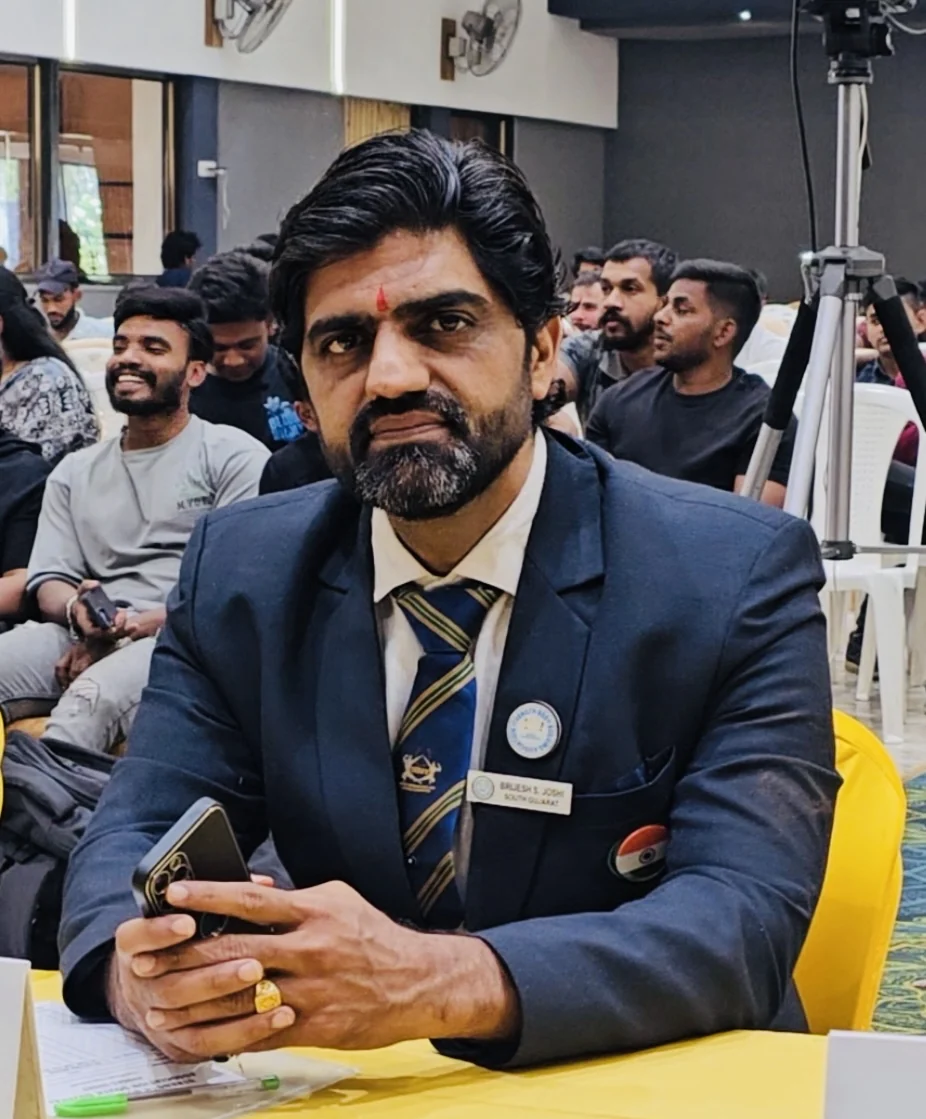
Written by Brijesh Joshi
Founder of S R Gym, Surat, coaching since 1999. President of the Strength Bodybuilding Association South Gujarat and a registered IBBFF judge. See credentials.
The two prices above settle the money question, and the rest of this page is about what decides whether both of you are still training in six months. The pairs who last here are usually the ones who worked out early that they are two separate members who happen to share a vehicle.
There is a couple rate and it covers twelve months for two people: ₹16,000 at Adajan, ₹18,000 at Katargam. Either way it saves the pair ₹2,000 against two twelve-month memberships bought separately, and works out at ₹667 per person per month at Adajan, ₹750 at Katargam. Every rate is on the fees page.
The bigger saving is on coaching, not on the floor. Two people trained together is ₹12,000 a month for the pair, which is ₹6,000 each, when one person training alone with a trainer is ₹7,000. Over three months it is ₹5,000 each against ₹6,000. That is not a promotion, it is what one coach's hour divided between two people costs.
Now the part a gym is not supposed to say about its own discount. A couple membership is one twelve-month commitment covering two people, and it does not unwind when one of you stops. If either of you is still finding out whether you will keep coming, two separate one-month memberships at ₹1,700 each cost you far less to be wrong about, and you can buy the couple year in March when you both have the evidence. The same caution applies harder to paired coaching, where you are also training on somebody else's schedule and getting half the attention. There is a wider look at city prices on the gym fees in Surat page.
| What you are asking about | What S R Gym publishes | What that means for two of you |
|---|---|---|
| Couple membership | ₹16,000 Adajan, ₹18,000 Katargam | Twelve months covering both of you, ₹667 and ₹750 each a month. One commitment, so it does not unwind if one of you stops. |
| Separate memberships | From ₹1,700 a month each | Held independently and may start on different days. Cheaper to be wrong about, which matters if either of you is new to this. |
| Personal training, two of you | ₹12,000 a month for the pair | ₹6,000 each, against ₹7,000 training alone. Charged on top of membership. |
| Family package | None beyond the couple rate | A parent and an adult child each take an ordinary membership. |
| What a membership includes | Floor access, the yoga and Surya Namaskar opening, and a programme I write for you | Both of you get the same inclusions, and your two programmes will usually differ. |
| Supplements | Not sold here at all | Nothing is added to either bill, and neither of you gets sold a tub on the way out. |
| S R Gym Adajan hours | 6 am to 10 pm, Monday to Saturday, closed Sunday | Suits pairs training after the school run or on the way home from an office nearby. |
| S R Gym Katargam hours | 5 am to 10 pm, Monday to Saturday, closed Sunday | The branch to choose when the only hour the two of you share is before work. |
If only one of you can be coached closely at the start, the pairing I suggest most often is one personal training and one membership, with the coached person carrying what they learn back into the house. The one on the membership still gets a written programme and still gets corrected on the floor.
Having a partner who is also training appears to help, and that is the part of this question with the most evidence behind it. A study in JAMA Internal Medicine in 2015 followed 3,722 married and cohabiting couples in England and found that 67 per cent of men whose partner became newly active became active themselves, against 26 per cent whose partner stayed inactive, with almost identical figures for women. It is observational, so it records that these changes travelled together rather than proving one caused the other, and everybody in it was aged 50 or above.
A review in Nutrition and Health in 2025 pooled eleven trials and found that couples lost roughly 2.25 kg more than people put through the same programme alone. The authors ask for caution because the studies varied widely, and those were structured clinical interventions rather than gym memberships.
Here is the part most fitness marketing leaves out. The only randomised trial I have found that split couples into training together against training apart appeared in the Journal of Racial and Ethnic Health Disparities in 2021, and it found no significant difference on any outcome, with nine couples taking part. Nine is far too small to settle anything either way. So a partner who is also training appears to help, while sharing the hour itself has yet to be shown to add to that.
Since the research does not settle it, the decision comes down to logistics and to what the two of you are like with each other. This table is built from what I watch on my own floor, and it carries no winning column.
| What you are weighing up | Both of you in the same hour | Two different hours |
|---|---|---|
| Getting there | One trip, one vehicle and one decision to leave the house. | Two trips, or the same vehicle used twice, which the household has to plan. |
| The days you do not feel like it | The other person is already at the door, and in my experience that gets a lot of sessions done. | Each of you decides alone, though a message afterwards does some of the same work. |
| Coaching attention | I move between the two of you, so each of you has me for part of the hour. | You each have my attention for your whole session, which suits a nervous beginner. |
| Equipment | You share a bench or a machine, and rest periods get arranged around that sharing. | Nothing to share, so you take the rest your programme actually asks for. |
| Comparing yourselves | You see every set the other one does, which is the hardest part to manage. | You hear about it later at home, and most people find that easier. |
| Your programmes | Written separately for each of you, however you arrive. | Written separately, with the same two rest days if you want a shared rhythm. |
What I suggest most often to couples on different shifts is that they keep the same two rest days and the same programme cycle while training hours apart. You then hold the shared calendar without needing the same alarm, and I offer that as my judgement rather than as a finding.
A gap in starting fitness derails a lot of couples, and it is the most common reason I see one half of a pair stop coming. Six weeks in, one of you is adding weight to the bar most sessions while the other is still on the same dumbbells, and the second person quietly starts telling themselves a story about being bad at this.
Research on exercise partners suggests that somebody moderately ahead of you motivates you, and the laboratory work behind that idea used software-generated partners rather than real spouses. The best known of those studies, in Annals of Behavioral Medicine in 2012, had 58 women with a mean age of 20 cycling in a laboratory. The idea matches what I watch on my own floor, and the evidence comes from nowhere near a married couple in Surat.
On the comparing itself, a randomised study in the Journal of Behavioral Medicine in 2024 found that people who compared themselves with someone performing better ended up with lower opinions of their own fitness and worse feelings about it. That was a laboratory task using invented feedback, and it measured mood rather than whether anybody stopped training. My own observation, offered as a coach's pattern rather than a measured finding, is that couples who compare numbers with each other tend to lose one member inside three months.
The fix is dull and it holds up. Each of you gets your own programme, your own log and your own numbers, and neither of you reads the other's book. If you are both new to this, the guide on the first 90 days covers the pace at which things move, and the results members have published show how different two timelines can be.
Two people who arrive together get two programmes. I have never found a good reason to break that rule, because a 42 year old man with a desk job and a 38 year old woman with a shoulder that clicks need different work even when they want the same outcome.
What you share is the shape of the hour. Every session at both branches opens with yoga and the twelve positions of Surya Namaskar before anybody touches a weight, and that has been the house rule since 1999. Those minutes are the one part a couple can genuinely do side by side, and after that the two of you are doing different things. There is more on the yoga and gym page.
Then I pair you on equipment that can be shared without either of you waiting. One does a set while the other rests, then you swap and the weight changes between you, which runs cleanly on machines and dumbbells. It runs badly on a barbell when one of you is loading twice the other, and there I split you across separate equipment. I am the head coach at both branches, so a pair sharing my attention gets less of it each than a single member on personal training does.
Ashutosh Banerjee, an IIT Bombay marketing professional who has trained at Adajan from 8 to 9 every morning since February 2026, told me in September 2026 that he had gone three months without his old neck and back pain, crediting the flexibility from daily Surya Namaskar. That is one member describing his own experience, and it is not evidence that the same will happen to anybody else.
A good number of the pairs on my floor are a parent and a grown son or daughter. If your child is still at school, from 14, that is a different conversation, set out in teen training. I am describing what I see across my two branches rather than a pattern anybody has measured across Surat. The usual shape is that the son or daughter joins first, then wants to bring in a father who has been told something about his blood sugar, or a mother whose knees have started complaining on the stairs.
On convincing a parent to start, here is what has worked for the families I have watched try it. Stop arguing about weight, because very few people over 55 want to discuss their weight with their own child. Talk about the stairs, the shoulder that will not reach the top shelf, the grandchild they want to be able to lift and the walk to the temple that has started to feel long. Offer to come with them for the first month at an hour that suits them. Ask them to speak to their doctor first and bring me what the doctor said, because the special population training certificate I hold from Dr Mahesh Kumar's Medical Institute is a fitness qualification and carries no medical authority.
It sometimes helps a family to know this is a national pattern rather than a personal failing. A pooled analysis of 507 population surveys in The Lancet Global Health in 2024 put the share of adults worldwide who are not active enough at 31.3 per cent. The India figure of 49.4 per cent in 2022, up from 22.3 per cent in 2000, comes from that paper's country data as reported in the Indian press rather than from the abstract I can read, and I quote it on that basis. Training in the second half of life has a page of its own on fitness after 40 in Surat.
Why physical activity matters
Nine minutes in Hindi on what sedentary work does to a body and on taking a first step rather than a perfect one. This is the one I send to families trying to talk a parent into starting.
If your parents live outside Surat, or the journey is genuinely impossible for them, I run online coaching and it is a reasonable option. For a nervous beginner over sixty I would rather have them in front of me for the first three months.
In a lot of the households I deal with, one person has the two-wheeler or the licence and the other does not, and that single fact decides more memberships than any programme detail. If you have to arrive and leave together, build the hour around whichever of you has less flexibility. Katargam opens at 5 am and Adajan opens at 6 am, both Monday to Saturday, and both are closed on Sunday, so a pair whose only shared window is before work should be looking at Katargam. The full hours are on the timings page.
The remaining practicalities are small and they matter more than they sound. Decide who is driving the night before, keep both sets of gym clothes in one place, and agree in advance what happens on the day one of you does not want to go. The rule that works best in my experience is that whoever wants to train goes anyway, and there is more for two people working long hours on the busy professionals page.
I would rather turn a pair away at the enquiry stage than take three months of fees from two people I cannot help. The second list below is the more useful of the two.
Who this is for
Who this is not for
Two categories of gym exist in this city and they sell genuinely different things. A budget chain sells access to a large floor, long hours, several locations and frequently a two-person card at a keen price. A coached gym of the kind I run sells you an hour with somebody in it who decides what each of you does, and it charges more per head for that.
When two people join at once the arithmetic pulls hard towards the budget chain, and I want to be fair about what that category does well. There are more machines at peak hour, so less waiting when a pair shares equipment. Several open on Sunday and keep longer hours, which matters if your only shared window is a Sunday morning, since both my branches are closed that day.
What a coached gym gives a pair is the part a two-person card cannot include. Two separate programmes written by somebody who has looked at both of you, a correction on the day the fitter one starts pushing the newer one into weights they have no business handling, and somebody who notices in the second week when one of you has stopped appearing. I am one person, which is the honest limit of what I offer two people at once. There is a longer piece on how to choose a gym in Surat and another on what makes a gym worth calling the best, and my credentials are documented in full.
Membership starts at ₹1,700 for one month, and personal training starts at ₹7,000 for one month. Both figures are per person and both are the rates everybody pays, set out in full on the fees page. Katargam opens at 5 am and Adajan opens at 6 am, Monday to Saturday, and both close at 10 pm.
Every figure on this page is stated the way the study reported it, including the trial that found no difference between couples training together and couples training apart. Where the evidence is thin, or comes from a population unlike the people I coach, the page says so in the same sentence as the claim.
JAMA Internal Medicine, 2015 · Observational cohort, 3,722 married and cohabiting couples aged 50 and above
Where one partner became newly physically active, 67 per cent of men became active themselves against 26 per cent of men whose partner stayed inactive. For women the figures were 66 per cent against 24 per cent. A newly active partner was associated with more change than a consistently active one. Being observational, it records that these things travelled together rather than proving one caused the other, and every participant lived in England and was aged 50 or above.
Nutrition and Health, 2025 · Systematic review and meta-analysis, 17 studies reviewed and 11 pooled
Couples-based programmes produced about 2.25 kg more weight loss than the same programmes delivered to individuals, with the range running from 0.88 kg to 3.63 kg. The authors ask for the result to be read with caution because the studies varied widely. What was measured was weight rather than fitness or attendance, and the programmes were structured clinical interventions rather than gym memberships.
Journal of Racial and Ethnic Health Disparities, 2021 · Randomised pilot trial, 9 couples, mean age 62.8
The only trial I have found that randomised couples to exercising together against exercising separately. There were no significant group by time interactions on any outcome measured. Training together trended towards more walking, 86.5 minutes a week against 66.1, without reaching statistical significance. Nine couples is far too small to settle the question in either direction, so this page treats it as a reason for caution rather than as a verdict.
Dimensional and social comparisons in a health fitness context
Journal of Behavioral Medicine, 2024 · Randomised laboratory experiment
Participants who compared themselves with someone performing better reported lower evaluations of their own fitness and more negative emotional reactions. The comparisons were produced with feedback the researchers supplied during a laboratory task, and the outcomes measured were mood and self-evaluation. Nothing in it shows that anybody stopped exercising, so it cannot be used to claim that comparison makes people quit.
Annals of Behavioral Medicine, 2012 · Randomised laboratory study, 58 women, mean age 20.5
Women cycling alongside a partner who performed better, in a condition where the pair's result depended on the weaker person, kept going for 21.89 minutes against 10.6 minutes when alone. The partner was virtually present rather than real, the task was stationary cycling in a laboratory and every participant was a young woman, so the size of the effect should not be carried across to a married couple on a gym floor in Surat.
The Lancet Global Health, 2024 · Pooled analysis of 507 population-based surveys
31.3 per cent of adults worldwide were insufficiently active in 2022, with women higher than men at 33.8 per cent against 28.7 per cent. The India figure of 49.4 per cent in 2022, risen from 22.3 per cent in 2000, comes from the same paper's country data as reported in the Indian press, since the abstract available to us stops short of the country table. It is quoted here on that basis.
This page is general information written by a fitness coach. It is not medical advice and it can tell you nothing about your own condition or your parents' condition. Where a heart problem, a pregnancy, uncontrolled blood pressure or diabetes is involved, speak to a doctor before the first session. There is more on the diabetes page.
The first conversation costs nothing and it usually settles which of you needs coaching and which of you needs a programme and a floor. Call +91 98790 69960 and ask for me, or send a message and tell me who is coming with you.