
S R Gym Adajan
3rd floor, above Way Wait Restaurant, near Deepa Complex, Krishna Nagar Society, Kalpana Society Part-2, Choksi Wadi,Adajan, Surat, Gujarat 395009
- Mon–Sat
- 06:00 am – 10:00 pm
- Sunday
- Closed
- Google rating
- 4.6 from 28 reviews
The short answer
A diet plan that works in Surat is built from the food your own kitchen already cooks, which is why the first thing I ask a member for is three days of photographs of their actual plates rather than a printed chart. For most people who train, the useful protein range is 1.4 to 2.0 grams for every kilogram they weigh, so a 70 kg adult is looking at roughly 100 to 140 grams a day, and a Gujarati kitchen gets a long way towards that with a full bowl of dal, curd twice, paneer or soya once, and milk at night, on top of the rotli and rice already on the thali. I sell no supplements of any kind at either branch, so nothing I tell you about food has a product attached to it. The food work sits inside coaching rather than being sold separately, and it comes with personal training from ₹7,000 for one month.
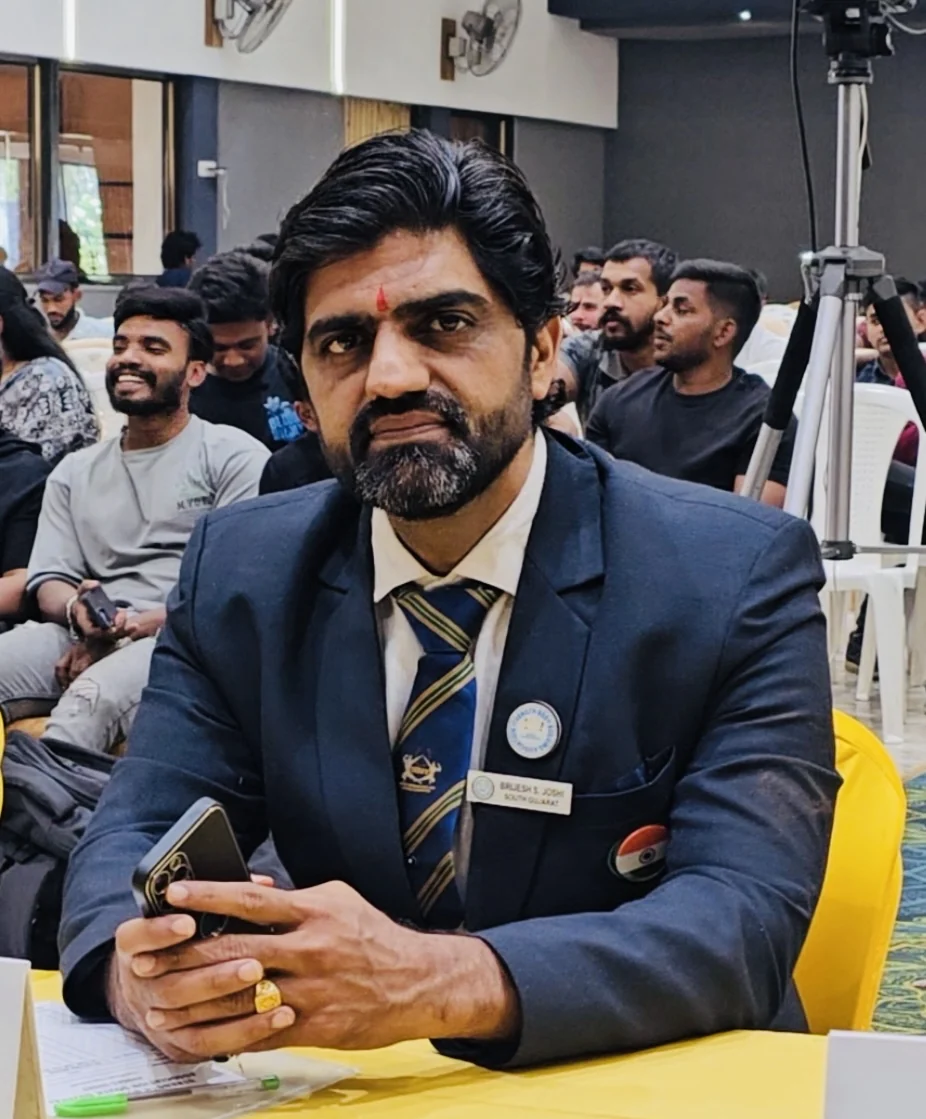
Written by Brijesh Joshi
Founder of S R Gym, Surat, coaching since 1999. President of the Strength Bodybuilding Association South Gujarat and a registered IBBFF judge. See credentials.
There is no single diet chart for the gym that suits everybody in Surat, because the two households on either side of yours cook differently, eat at different hours and fast on different days. What I do instead is start from the food your family already puts on the table, count what that food is actually giving you, and change the smallest number of things that will move the result.
A printed chart is written for an average person who does not exist. It assumes you can cook separately from your family, that you eat at fixed hours, that nobody in the house fasts, and that the farsan at four o'clock and the two cups of sugared tea before it are somehow not part of the day. Most of the charts I am shown by new members were produced without a single question about who does the cooking.
In my experience since 1999, a member follows a chart like that for somewhere around ten days and then quietly goes back to the household menu, feeling that they have failed at something. That ten day figure is my own observation across the people I have coached rather than anything published, and I state it as my judgement so you can weigh it as such. The food itself was rarely the problem. The plan was simply built for somebody else's kitchen.
The two things a chart usually gets wrong in a Gujarati home are the quantity of protein, which in the days members send me usually sits well below what a person training four days a week needs, and the quantity of oil, which very few people estimate accurately from memory. Fixing those two costs you no new ingredients at all.
The first thing I ask for is three ordinary days of photographs, every plate, every glass of tea, every packet opened in the evening. I want an ordinary week rather than a good week, because a plan built on your best behaviour collapses in the second month. Then I ask who cooks, how much of the menu you can influence, what time you get home, which days the family fasts, and how many litres of oil the house buys in a month, since the tin is a far more honest number than anybody's memory of how many spoons went into the shaak.
From that I count the protein and the rough calories of the day you already eat, and I set a target. Then we change three things, usually a full bowl of dal instead of a ladleful, curd at both main meals, and a roasted evening snack in place of a fried one. I use katoris, bowls and the number of rotli wherever I can, because a member who has to weigh every plate on a kitchen scale will stop within a fortnight. We look at it again after two weeks and change the next thing, and that cycle continues for as long as you train with me.
The training side is not separate from this. Every session at both branches opens with yoga and the twelve positions of Surya Namaskar before anybody touches a weight, which has been the house rule since 1999, and the way the whole thing fits together is set out in the method I coach.
The number worth planning around comes from the International Society of Sports Nutrition position stand published in 2017, which puts the useful daily range at 1.4 to 2.0 grams of protein per kilogram of bodyweight for most exercising people. For a 70 kg adult that is roughly 100 to 140 grams a day. If you are already lean and eating in a deficit, the same document goes higher, to 2.3 to 3.1 grams per kilogram, which is a range that applies to very few of the people who walk into my gym.
The figure everybody quotes online, 1.62 grams per kilogram, comes from a pooled analysis of 49 randomised trials in the British Journal of Sports Medicine in 2018, which found that the gain in fat-free mass stopped rising above about that intake. Two honest qualifications belong in the same sentence as that number. Its statistical range ran from 1.03 to 2.20 grams per kilogram, so quoting 1.62 as though it were precise claims more than the data support, and the average benefit across all those trials was 0.30 kg of fat-free mass, which tells you that protein is one lever among several rather than the whole answer. I should also say that the journal published a correction to that paper in 2020 which I have not been able to read.
When I count the days members send me, most Gujarati days land somewhere between 40 and 60 grams before anything is changed. That counting is mine rather than a published survey, and the gap it shows is the reason I most often find behind a person training hard for a year and seeing very little for it. A number worked out from your own weight is more use than any of these ranges, and the calculators here will give you one.
A review of national dietary data in the British Journal of Nutrition in 2012 reported that about 60 percent of the protein Indians eat comes from cereals, and that lysine is the amino acid most limiting in cereal protein. Rotli, bhakhri, rice and bajra all carry protein of a kind that runs short on lysine, and the correction sits right beside them on the thali in the form of dal, dairy and soya. The same paper found that shifting the cereal to legume ratio from 80:20 towards 60:40 improves lysine adequacy without adding a gram of animal protein, which in a Gujarati house means more dal for the same number of rotli.
That paper describes rural, slum and tribal populations, so I am not telling you that your own diet is deficient. It describes a dietary pattern worth watching, and if you drink milk daily and eat a proper bowl of dal you are already in better shape than the populations it studied.
A controlled feeding study in Indian men published in The Journal of Nutrition in 2020 makes the point more usefully. Lysine availability measured 86.6 percent from a vegetarian cereal and legume meal against 91.9 percent from spray-dried milk powder, so a properly combined thali sits close to milk rather than far behind it. The same study found heat-treated milk powder fell to 69.9 percent, a drop of about 22 percent, which is a measured reason to prefer milk as your own kitchen handles it over a heavily heat-treated powder. That was measured in milk powder rather than across processed food in general, so I hold the finding to what it actually tested. There is more on assembling this across a day in my guide to protein for Indian vegetarians.
Every row below says whether the food is weighed dry or cooked, because that single detail is where most people go wrong by a factor of three.
| Food, weighed as stated | Protein | What to watch |
|---|---|---|
| Soya chunks, 50 g dry | about 25 g | Weigh the chunks while they are still dry. The same 50 g swells to roughly 150 g once soaked, so a member who weighs the soaked chunks will overestimate by around three times. These are defatted soya flour rather than the whole bean. |
| Whole soya bean, 100 g dry | about 36 g | ICMR-NIN's Indian Food Composition Tables 2017 give 35.58 g for brown soyabean and 37.80 g for white, the highest of any pulse in the book. |
| Paneer, 100 g | about 18 to 20 g | Also carries a good deal of fat, so the portion decides whether it helps or hurts while you are eating in a deficit. |
| Curd, 200 g | about 6 to 8 g | The easiest single addition to a Gujarati lunch, and dairy is where the lysine your rotli lacks is easiest to find. |
| Milk, 250 ml | about 8 g | A glass at night, plus whatever goes into tea across the day. |
| Bengal gram or chana, 100 g dry | about 17 g | IFCT 2017 puts bengal gram at 17.08 g per 100 g, the lowest of the pulses, and soya bean at the top of the same range. |
| Toor dal, one full cooked bowl of about 150 g | about 6 to 9 g | The figure looks small because a cooked bowl is mostly water. Serving a full bowl twice a day matters far more than the exact number. |
| Moong dal, one full cooked bowl | about 7 to 9 g | Usually the easiest of the dals for people who complain of gas. |
| Rajma, one cooked bowl | about 8 g | This brings a useful amount of fibre alongside the protein. |
| Peanuts, 30 g | about 8 g | Calorie dense, so measure a portion out rather than eating from the container. |
| Wheat rotli, two medium | about 6 g | Modest per rotli and meaningful across a whole day, and low in lysine, which is the reason the dal beside it earns its place. |
| Egg, one whole, for members who eat them | about 6 to 7 g | IFCT 2017 gives 13.28 g per 100 g of raw whole egg, and an egg weighs roughly 50 g. |
The two figures credited to ICMR-NIN's Indian Food Composition Tables 2017 are read from that book. The rest are the working approximations I coach with, and they move with the variety of the pulse, the size of the rotli and how much oil goes into the pan, so use them to plan a day rather than to audit one. Dhokla, handvo, thepla and khichdi are missing deliberately, since their protein depends entirely on whose recipe is followed and a single number for them would be invented. Gujarati dal is also usually cooked with jaggery, which changes nothing about its protein and does add sugar to the day.
A randomised trial published in Sports Medicine in 2021 put 19 vegans and 19 omnivores through twelve weeks of supervised lower-body resistance training with protein matched at 1.6 grams per kilogram of bodyweight. Both groups increased leg lean mass and strength, with no statistically significant difference between them on the measures the trial reported. The lesson I take from it is that the total is what matters and the source matters less than most people assume.
The detail that most articles quoting this trial leave out is that both groups reached their target using isolated protein supplements, soy isolate for the vegans and whey for the omnivores. So the trial shows that a plant-based total of 1.6 grams per kilogram works, and it does not show that the result came from whole food alone. It also ran on 38 young men for twelve weeks on lower-body training, which is a small study by any measure. Reaching that total from a Gujarati kitchen is achievable and it takes deliberate planning, which is exactly what muscle gain coaching is for.
Nobody has ever shown me the study behind that ratio, and I have looked, so my honest answer is that 70 and 30 are numbers somebody invented for a caption. What the evidence supports is narrower and more useful. A 2014 review in the Journal of the Academy of Nutrition and Dietetics compared diet-only programmes against diet-plus-exercise programmes and found no significant difference at three to six months, with greater weight loss for the combined programmes at twelve months. I have read that review at abstract level rather than in full, which is why no effect sizes appear here.
The reason food carries more of the load for fat loss is arithmetic. It takes a few minutes to leave 500 calories on the table and a long uncomfortable hour to burn the same on a treadmill. Training earns its place by deciding how much of the weight you lose comes off fat instead of muscle, and by the twelve month mark the people doing both were ahead. If fat loss is your goal, read the practical version in the Gujarati diet guide and the training side in weight loss coaching.
There is no supplement counter at Adajan or at Katargam, and there never has been. An analysis of 36 popular protein supplements sold in India, published in Medicine in 2024, found that 25 of them contained less protein per 100 grams than the label claimed, with shortfalls running from under 10 percent to more than 50 percent, and two products from a single manufacturer measuring 62 percent and 50.4 percent below label. It was a convenience sample tested by one self-funded laboratory and the industry has disputed it, so I quote it as one serious piece of evidence rather than as the last word.
I want to be fair to the other side of this. The sports nutrition position stand I cited earlier describes supplementation as a practical way of ensuring adequate protein, so the honest position is that a scoop is a convenience for a day when your meals fall short. Buying powder while your food still provides 50 grams is spending money to avoid a change that costs nothing, and since I sell none of it, there is nothing in either answer for me.
The same principle covers the other thing people ask me quietly. I do not coach anabolic steroid use at any level, for any competition, at any age, and my reasons are set out in full in the guide to steroids and bodybuilding in India.
Diet coaching is slow work and it pays off only when the person on the other side of it can change what is cooked. The second list is the one I would read first if I were you, because turning away the wrong member early is better for both of us than a refund conversation in month two.
Who this is for
Who this is not for
A budget chain sells you access to a room and, increasingly, a diet chart generated by an app from a database of Indian meals. It is cheaper, it often opens longer hours, and the chart arrives within a minute of you entering your weight. For somebody who already knows how to eat and only wants a place to train, that is a perfectly sensible purchase and I will say so to anybody who asks me.
A coached gym costs more, and what you are buying is a person who asks whose kitchen it is before saying anything about your food. The difference shows up in the second month, when the app chart has been abandoned and the coached plan has been adjusted twice because your mother-in-law cooks on Sundays and you fast on Ekadashi. A third category exists as well, the diet clinic, where a qualified dietitian measures you and prescribes, and that is the right door when a medical condition is driving the eating.
I will not name another gym in Surat on this website, in either direction. If you are still weighing the options, how to choose a gym in Surat sets out the questions I would ask if I were the one paying.
I am a trainer and a coach. I hold a GFFI personal trainer certification, an advance fitness personal trainer certificate and a special population training certificate from Dr Mahesh Kumar's Medical Institute, and EKFA functional training level 1 from Mumbai in October 2016, and every one of those is scanned and published on my credentials page. What I do not hold is a degree in dietetics, and I would rather say that plainly here than have you find it out later.
Medical nutrition therapy belongs with a registered dietitian working alongside your doctor. That applies if you are managing diabetes, thyroid disease, PCOS, kidney disease or a pregnancy, and I am glad to train you around whatever they set, which is how I already work with several members and is described on the page about training with diabetes.
One specific caution about the protein figures on this page. Intakes in this range have not been shown to harm healthy kidneys, and they are not established as safe in chronic kidney disease. If your kidney function is impaired, the numbers here are not yours to use and the question belongs with your nephrologist.
Membership starts at ₹1,700 for one month, and personal training, which is where the structured food work sits, starts at ₹7,000 for one month. There is no separate charge for a diet plan at either branch, because I do not sell one as a product. The full fee list and the timings for both branches are published, and you are welcome to call +91 98790 69960 before you visit.
Two of these papers argue against parts of my own position and I have listed them anyway, because a reader deserves to see that rather than a tidy row of studies that all agree with me. One further review, on diet against diet plus exercise, is named in the text without a link here, since I have read its abstract rather than its full text.
British Journal of Sports Medicine, 2018 · Meta-analysis of 49 randomised trials, 1,863 participants
Protein supplementation added roughly 0.30 kg of fat-free mass and about 2.49 kg to one-rep-max strength. The gain in fat-free mass stopped rising at around 1.62 g of protein per kg per day, with a statistical range of 1.03 to 2.20, so it is an average with a wide band rather than a personal ceiling. The journal published a correction to this paper in 2020 which I have not yet been able to read.
International Society of Sports Nutrition position stand: protein and exercise
Journal of the International Society of Sports Nutrition, 2017 · Expert position stand
Puts the useful daily range at 1.4 to 2.0 g per kg for most exercising people, and at 2.3 to 3.1 g per kg for lean trained people eating in a deficit. The same document calls protein supplementation a practical way of ensuring adequate protein, and rates dairy and animal protein above a protein-matched vegetarian control for hypertrophy, so it argues against parts of what I tell members.
Sports Medicine, 2021 · Randomised trial, 38 young men, 12 weeks
Vegans and omnivores gained the same leg lean mass and strength over 12 weeks once protein was matched at 1.6 g per kg. Both groups reached that total using isolated protein supplements, soy isolate for the vegans and whey for the omnivores, so the trial shows that the total is what counts and it does not show that whole food alone produced the result.
British Journal of Nutrition, 2012 · Review of national dietary data
Around 60 percent of dietary protein in India comes from cereals, and lysine is the amino acid most limiting in cereal protein. Moving the cereal to legume ratio from 80:20 towards 60:40 improves lysine adequacy without adding any animal protein. The shortfalls described are in rural, slum and tribal populations, so they describe a dietary pattern to watch rather than a diagnosis of a Surat member who drinks milk daily.
Metabolic availability of lysine in milk and a vegetarian cereal-legume meal in Indian men
The Journal of Nutrition, 2020 · Controlled feeding study in Indian men
Lysine availability measured 91.9 percent from spray-dried milk powder, 86.6 percent from a vegetarian cereal and legume meal, and 69.9 percent from heat-treated milk powder. Heavy heat treatment cut lysine availability by about 22 percent, which is a measured reason to prefer food cooked at home over heavily processed products.
Medicine (Baltimore), 2024 · Laboratory analysis of 36 products sold in India
25 of the 36 popular protein supplements analysed contained less protein per 100 g than the label claimed, with shortfalls running from under 10 percent to over 50 percent, and two products from one manufacturer measured 62 percent and 50.4 percent below label. It is a convenience sample of popular products tested by a single self-funded laboratory, and the industry has contested it.
This page is general information written by a fitness coach who holds personal training and special population certificates and no dietetics degree. It is not medical nutrition therapy, it cannot account for your own health history, and it should not be used to change medication or to manage a diagnosed condition without your doctor.
That is genuinely how this starts, and it costs you nothing to ask a question first. Call +91 98790 69960 or send the photographs across.
Free, no sign-up, and the arithmetic is explained on each page.