
S R Gym Adajan
3rd floor, above Way Wait Restaurant, near Deepa Complex, Krishna Nagar Society, Kalpana Society Part-2, Choksi Wadi,Adajan, Surat, Gujarat 395009
- Mon–Sat
- 06:00 am – 10:00 pm
- Sunday
- Closed
- Google rating
- 4.6 from 28 reviews
The short answer
Yes, you can start at sixty, and I coach members over sixty at both S R Gym branches in Surat, in Adajan and in Katargam. Every session opens with yoga and the twelve positions of Surya Namaskar, strength work is loaded in small steps on machines before free weights, and balance work sits in the programme on most days because that is the part with the strongest evidence behind it for older adults. I hold a special population training certificate from Dr Mahesh Kumar's Medical Institute, which is a fitness qualification rather than a medical one, so I ask every member over sixty to speak to their own doctor before the first session. Membership starts at ₹1,700 for one month and personal training at ₹7,000 for one month.
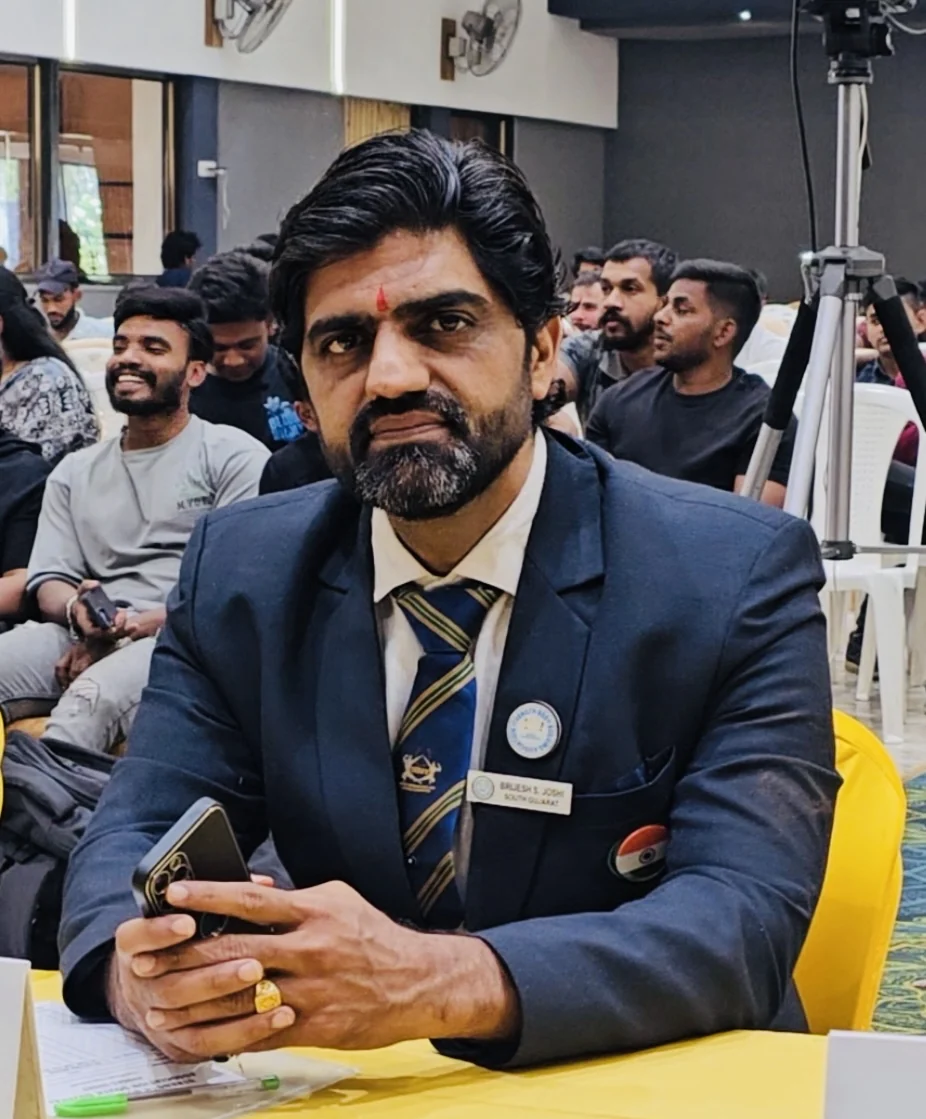
Written by Brijesh Joshi
Founder of S R Gym, Surat, coaching since 1999. President of the Strength Bodybuilding Association South Gujarat and a registered IBBFF judge. See credentials.
I coach members over sixty at both branches, and I have been doing it since the gym opened in 1999. Many of them arrive because a doctor or a grown child told them to do something about their strength, and many are quietly worried that lifting anything at their age is asking for an injury. This page sets out what the research supports, where my own coaching judgement takes over, and what a week of fitness training for old age looks like at S R Gym.
Supervised, sensibly loaded weight training has a good safety record in this age group, and the evidence behind that is better than most families expect. In one supervised trial of 101 women averaging 65 years of age, every one of them already carrying thinning bones, published in the Journal of Bone and Mineral Research in 2018, eight months of twice weekly training at loads above 85 per cent of a single repetition maximum produced one adverse event in the entire study, a minor lower back spasm that cost two sessions out of seventy.
Read that carefully before you take too much comfort from it. Everybody in the trial was a woman, everybody was screened for conditions and medicines that affect bone, every session was supervised, and it remains one trial with 101 participants. What I take from it as a coach, and this is my reading rather than the finding itself, is that the risk of careful supervised lifting has been overstated for this age group while the risk of sitting still has been understated. A cross-sectional study of 26,780 older Indians in the Journal of the American Geriatrics Society in 2025 found low muscle mass with low strength or slow walking in 43.6 per cent of adults aged 60 and above, and that design cannot establish cause.
Every member over sixty is asked to speak to their own doctor before the first session, and that is my rule for my gym rather than a universal medical requirement. The American College of Sports Medicine relaxed its pre-participation screening advice in 2015 because blanket clearance requirements were acting as a barrier to physical activity, particularly for older adults, and an analysis in Medicine and Science in Sports and Exercise in 2017 estimated that the older standard would have referred roughly 95 per cent of adults over 40 to a physician before they started exercising. Nobody is served by a rule that strict.
There are situations where the doctor's visit is far more than a formality. The American Heart Association's 2000 statement on resistance exercise names uncontrolled high blood pressure, unstable angina and uncontrolled irregular heart rhythms among the conditions to settle first, and it treats a reading at or above 180 over 110 as a reason to leave the weights alone until it is controlled. If you take medication for your heart, your blood pressure or your blood sugar, tell me what your doctor said and I will build around it, and there is a separate page on training with diabetes.
My special population training certificate from Dr Mahesh Kumar's Medical Institute is photographed on the credentials page, with the issuing institute named, so you can see exactly what it is. It is a fitness qualification. It equips me to write and supervise a programme for an older adult. It does not equip me to diagnose a condition, read your reports, clear you medically or rehabilitate an injury, and I will send you to the right professional for any of those.
I would rather turn somebody away at the enquiry stage than take three months of fees from a person I cannot help. Both lists below are written plainly for that reason.
Who this is for
Who this is not for
The exercises mostly stay the same and the way they are introduced changes completely. The three things that matter most, in my judgement after coaching this group since 1999 rather than because a study says so, are the pace at which load goes up, the choice between a machine and a free weight in the first months, and how much of the hour goes on getting into and out of positions safely.
Load rises in small steps and it stops rising the moment technique starts to wobble. New members over sixty begin on machines for the big patterns, because a machine holds the path while somebody learns it, and free weights arrive once the pattern is reliable. Rest between sets is longer than a younger member would take. Grip, hip and ankle work sit in every programme, because those joints have a great deal to do with whether a person gets up off the floor unaided, which is what families genuinely worry about. Where there is a stiff or rounded upper back, posture work goes in from the first week. The approach is the same strength training I coach at every age, slowed down and watched more closely.
The Cochrane review of exercise for preventing falls, updated in 2019, pooled 59 trials and 12,981 people and found that exercise programmes reduced the rate of falls by about 23 per cent, which the reviewers graded as high certainty evidence. The component that carries that result is balance and functional training, where 39 trials and 7,920 people gave a reduction of about 24 per cent.
Here is the part most gym pages get wrong, and I want to state it clearly. The same review says it is uncertain about the effect of resistance training on its own for preventing falls, so the weights I coach have not earned that 24 per cent and I will not claim it for them. What the evidence supports is putting balance and functional work into the programme deliberately, which is why standing balance holds, step ups, sit to stand repetitions and controlled turning appear on most training days here. Those are population averages across thousands of people, and they say nothing certain about you.
This is a representative week for a member in their sixties who has been training with me for two or three months. The first fortnight is lighter than this, and the yoga opening is there from day one. Both branches are open Monday to Saturday and closed on Sunday.
| Day | Where | What the session is | About how long |
|---|---|---|---|
| Monday | Gym | Yoga and the twelve positions of Surya Namaskar, then lower body strength on machines, finishing with standing balance holds | 60 minutes |
| Tuesday | Home or outdoors | A steady walk at a pace that still allows conversation, before the heat of the day | 40 minutes |
| Wednesday | Gym | Yoga opening, then upper body pulling and pressing, then sit to stand repetitions and step ups | 60 minutes |
| Thursday | Home or outdoors | A steady walk, plus the balance holds you were taught, done beside a kitchen counter you can reach | 40 minutes |
| Friday | Gym | Yoga opening, a full body strength session, then walking heel to toe and turning under control | 60 minutes |
| Saturday | Gym | A longer yoga and mobility session with no heavy loading at all | 45 minutes |
| Sunday | Both branches closed | Rest, or a walk with the family if you feel like one | Your choice |
The same 2018 trial measured bone density at the spine and the hip after eight months. At the lumbar spine the training group gained about 2.9 per cent while the comparison group lost about 1.2 per cent, and that is a genuine gain. At the hip the training group changed by 0.3 per cent, which is indistinguishable from no change at all, while the comparison group lost 1.9 per cent, so the honest sentence about the hip is that the training group held on to what they had while the comparison group lost ground.
Two further things belong in the same breath. The trial measured density on a scanner and it never measured broken bones, so nobody can honestly tell you that training prevents a fracture on the strength of it. The spread around those averages was wide enough that some individuals in the training group will have lost density too, and I cannot tell you in advance which side of the average you will land on. A supervised programme is a reasonable thing to do about bone health, and your doctor is the person to decide about scans and medication.
Every session at both branches opens with yoga and the twelve positions of Surya Namaskar before anybody touches a weight, and that has been the house rule since 1999. For a member over sixty it does more work than it does for a twenty year old, because stiff joints take longer to warm and the positions themselves rehearse getting down towards the floor and back up again under control.
The clearest research on yoga here happens to be in older adults. A meta-analysis of 22 randomised trials in the International Journal of Behavioral Nutrition and Physical Activity in 2019 found that yoga improved balance and lower body flexibility against people who were not exercising at all, with effect sizes of 0.70 and 0.50. That comparison group matters and I am not dropping it, because when the same review set yoga against other forms of exercise the balance advantage was no longer statistically significant. The fair reading is that yoga looks better than doing nothing for balance, and that this review could not separate it from other kinds of exercise, which is a weaker statement than saying the two are equal. The review found no significant effect on fear of falling, so I claim none.
Ashutosh Banerjee, a marketing professional from IIT Bombay who trains at Adajan from 8 am to 9 am and has done since February 2026, told me in September 2026 that he had gone three months without the neck and back pain he used to live with, and he credits the daily Surya Namaskar for the flexibility. That is one man's account of himself, and it is not evidence that this reliably works for anybody else. There is more in the guide to Surya Namaskar before weight training and on the page about combining yoga and gym in Surat.
Families comparing options for an older parent are choosing between two categories rather than two signboards. The table below is my own reading of those models, drawn from what members tell me when they move between them, and it is coaching judgement rather than research. I will not name another gym in Surat on my own website.
| What you are comparing | A coached gym of this kind | A large budget chain |
|---|---|---|
| Who writes the programme | Here, I write it myself. I have coached older members since 1999 and I hold a special population training certificate | Often whichever floor trainer is on shift that month |
| Who watches the first sets | I stand with you, or a trainer I have taught does, until the pattern is safe to do alone | Usually you, with a member of staff available if you ask |
| Warm up | Yoga and Surya Namaskar before weights, on every session, for everybody | Generally left to the member, commonly skipped |
| Whether anyone knows your medical history | Asked for at the start and kept in mind while programming | Collected on a form at joining and rarely referred to again |
| Peak hour experience | A smaller floor, where waiting for a machine is short | A bigger floor with more equipment and more competition for it |
| What it costs | ₹1,700 for one month here, with coaching included in the price | Frequently cheaper, and I will say plainly that this is a real advantage if all you want is floor access |
| Supplements | None sold here at all, and no steroid coaching at any level | Commonly sold at the counter as a separate line of business |
If you are weighing this up more broadly, I have written a longer piece on how to choose a gym in Surat that applies at any age.
Plenty of my enquiries come from adult children in another city who want their parents in Surat looked after, and plenty more from families whose parent will not agree to a gym yet. At home, the useful work is walking on most days at a pace that still allows conversation, standing up from a firm chair and sitting down again for a few sets, holding a balance position beside a counter that can be grabbed if needed, and the twelve positions of Surya Namaskar once a teacher has shown them how. That covers aerobic work, leg strength and balance, which are the three things the World Health Organization asks for. Loaded strength work is the piece a home without equipment cannot supply.
If the parent lives in Surat and the family does not, bring them in and I will talk to them for as long as it takes. Personal training is usually the right shape for the first three months, because every session is watched. If they live somewhere else entirely, online coaching can carry a programme and video checks of technique, and it is a weaker arrangement than standing next to somebody. Anyone in their forties or fifties reading this for themselves may find the page on training after 40 a closer fit.
Membership starts at ₹1,700 for one month, and personal training starts at ₹7,000 for one month. Those are the same published rates everybody pays, and they are set out in full on the fees page. Katargam opens at 5 am and Adajan opens at 6 am, Monday to Saturday, and both close at 10 pm, with the full timings here.
Every number quoted on this page is stated as the study reported it, including the ones that are smaller or weaker than a gym would prefer. Where a finding does not support a claim, such as resistance training on its own for preventing falls, the claim is not made.
Journal of Bone and Mineral Research, 2018 · Randomised controlled trial, 101 women, mean age 65
Eight months of supervised twice weekly training above 85 per cent of a one repetition maximum produced one adverse event, a minor back spasm costing two sessions out of seventy. Lumbar spine bone density rose 2.9 per cent against a loss of 1.2 per cent in the comparison group. At the femoral neck the training group changed by 0.3 per cent, which is indistinguishable from no change, while the comparison group lost 1.9 per cent. Fractures were not measured.
Exercise for preventing falls in older people living in the community
Cochrane Database of Systematic Reviews, 2019 · Systematic review of randomised trials
Exercise reduced the rate of falls by about 23 per cent across 59 trials and 12,981 people, graded high certainty. Balance and functional training carried the result, about 24 per cent across 39 trials and 7,920 people. The reviewers state they are uncertain about the effect of resistance training on its own.
International Journal of Behavioral Nutrition and Physical Activity, 2019 · Systematic review and meta-analysis of 22 randomised trials
Against inactive comparison groups, yoga improved balance with an effect size of 0.70 and lower body flexibility with an effect size of 0.50. Against other forms of exercise the balance difference was no longer statistically significant. No significant effect was found on fear of falling.
WHO Guidelines on Physical Activity and Sedentary Behaviour
World Health Organization, 2020 · Guideline, evidence graded
Adults aged 65 and above are advised to do 150 to 300 minutes of moderate aerobic activity a week, muscle strengthening work on 2 or more days, and multicomponent activity emphasising balance and strength on 3 or more days to help prevent falls.
Updating ACSM's Recommendations for Exercise Preparticipation Health Screening
Medicine & Science in Sports & Exercise, 2015 · Position stand
Screening was deliberately relaxed because blanket medical clearance requirements were acting as a barrier to physical activity, particularly for older adults.
Application of the ACSM Preparticipation Health Screening Algorithm to US Adults
Medicine & Science in Sports & Exercise, 2017 · Population analysis
The previous screening standard would have referred roughly 95 per cent of adults over 40 to a physician before exercise. The revised algorithm reduced referrals by about 41 per cent.
Resistance Exercise in Individuals With and Without Cardiovascular Disease
Circulation, American Heart Association, 2000 · Scientific statement
Uncontrolled high blood pressure, unstable angina and uncontrolled irregular heart rhythms are listed among the situations requiring medical management before resistance training, with a reading at or above 180 over 110 treated as an absolute contraindication.
Prevalence of sarcopenia and its associated factors among older adults in India
Journal of the American Geriatrics Society, 2025 · Cross-sectional analysis of 26,780 adults
Sarcopenia, meaning low muscle mass alongside low strength or slow walking, was reported in 43.6 per cent of Indian adults aged 60 and above, with severe sarcopenia in 19.4 per cent. Being cross-sectional, it cannot establish cause.
This page is general information written by a fitness coach who holds a special population training certificate. It is not medical advice, it can tell you nothing about your own condition, and nothing on it should be used to change a medicine. Speak to your doctor first, and keep seeing them.
The first conversation costs nothing and it settles most of what follows, including whether I am the right person for the job. Call +91 98790 69960 and ask for Brijesh Joshi.