
S R Gym Adajan
3rd floor, above Way Wait Restaurant, near Deepa Complex, Krishna Nagar Society, Kalpana Society Part-2, Choksi Wadi,Adajan, Surat, Gujarat 395009
- Mon–Sat
- 06:00 am – 10:00 pm
- Sunday
- Closed
- Google rating
- 4.6 from 28 reviews
The short answer
A home workout is enough for a great deal of what most people want, and it stops being enough at the point where your own bodyweight can no longer make a session hard. The World Health Organization's 2020 guidelines are written in terms of activity and intensity rather than venue, asking adults for 150 to 300 minutes of moderate activity a week along with muscle strengthening work covering all the major muscle groups on 2 or more days, and a well-built session in your own front room can meet all of that. What a gym adds is external load, which matters most for maximum strength and for the legs, hips and back where bodyweight runs out first, along with somebody watching how you move and the plain commitment of having left the house. My honest position, after running S R Gym in Surat since 1999, is that the home workout you actually do beats the membership you never use, so begin with whichever one you will keep doing and change it later if you outgrow it.
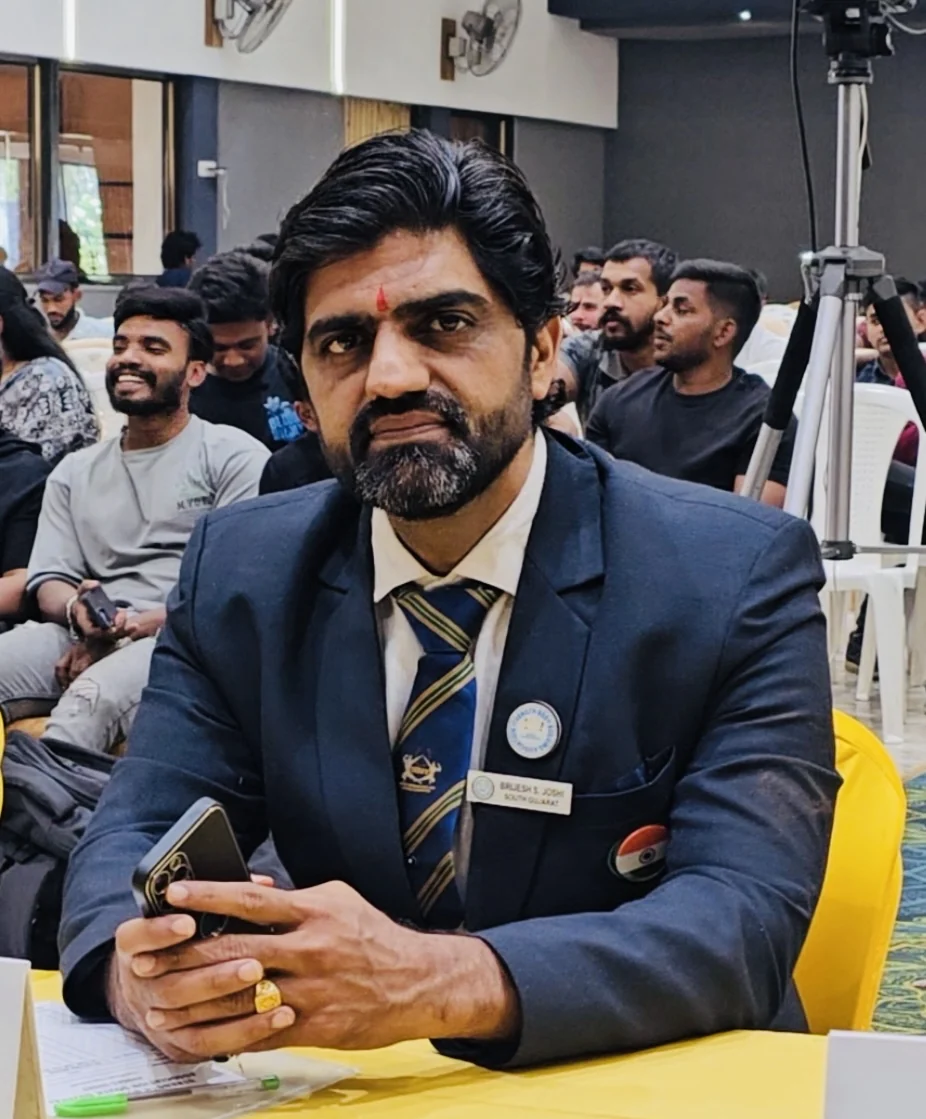
Written by Brijesh Joshi
Founder of S R Gym, Surat, coaching since 1999. President of the Strength Bodybuilding Association South Gujarat and a registered IBBFF judge. See credentials.
I own two gyms in Surat, so you should read everything below knowing that I have an obvious interest in the answer. I have tried to write it the way I answer the same question on the phone, which is by telling people the truth and losing the ones who were never going to come anyway. It is worth knowing that a great many of the articles arguing the other way are published by companies selling home equipment, so their conclusion is exactly as interested as mine.
A home workout is enough for most of what most people are actually after, which is being healthier, moving without pain, holding a reasonable amount of muscle and getting their weight to a place they are happy with. The clearest way to show you that is to look at what the target itself says. The World Health Organization's 2020 guidelines on physical activity ask adults aged 18 to 64 for at least 150 to 300 minutes of moderate intensity activity a week, or 75 to 150 minutes of vigorous activity, together with muscle strengthening work at moderate or greater intensity covering all the major muscle groups on 2 or more days a week.
Every one of those numbers describes activity and intensity, and not one of them mentions a venue. A room with a mat in it can meet that guideline in full, and I would rather tell you so plainly than pretend otherwise on a page published by a gym. For scale on how few people reach it, the World Health Organization reported in June 2024 that around 31 per cent of adults worldwide, roughly 1.8 billion people, were not active enough in 2022, and that the figure across South Asia was 45 per cent. That release gives no separate number for India, so I will not invent one.
Home wins on cost, and there is no argument to be had about it. Our membership starts from ₹1,700 for one month, published in full on membership and fees, while a mat and a little floor space cost you once. Home wins on travel too, since the ride to Adajan or Katargam is real time out of a working day, twice, and a session that starts the moment you stand up survives a bad week far better.
Home wins on privacy, which matters to more people than will admit it, and it matters a great deal to women starting out and to anybody who is heavier than they want to be right now. Nothing is ever occupied at home, so you never stand about waiting for a bench. Above all, home wins the row that decides everything, which is that a workout you actually do beats a membership you stop using in week three.
There is some evidence behind that last point. A Cochrane review in 2017 pooled 23 trials covering 2,890 people and found no evidence of a difference between home-based and centre-based rehabilitation in mortality or exercise capacity, on evidence the reviewers themselves graded low to very low, with programme completion slightly higher at home, a risk ratio of 1.04 whose confidence interval ran from 1.00 to 1.08. Those were cardiac rehabilitation patients rather than healthy people chasing muscle, and the lower end of that interval sits exactly on 1.00, so the advantage is slight and I would not stretch it further than that.
People are also poor at predicting their own attendance. An analysis of 7,978 health club members published in the American Economic Review in 2006 found that members paying a flat monthly fee of more than $70 turned up about 4.8 times a month, well below what they had signed up expecting of themselves. Those were three clubs in the United States more than 20 years ago, so the money figures in that paper say nothing at all about prices here, and I am assuming the behaviour it measured travels, which is my own reading rather than something that study tested. Assume you will go less often than you imagine, and choose accordingly.
Yes, and I say that as somebody whose living depends on the opposite being believed. A meta-analysis by Schoenfeld and colleagues in the Journal of Strength and Conditioning Research in 2017 pooled 21 studies comparing light loads with heavy loads and found that gains in maximum strength were significantly greater with heavy load, while muscle growth came out similar between the two as long as the sets were taken to the point of momentary failure, which was a condition of being included in that analysis. Push-ups, dips, split squats and rows off a sturdy table are all capable of taking a set to that point, particularly in somebody who has not trained before.
A single trial gives you a feel for how far bodyweight goes. Kotarsky and colleagues, in the same journal in 2018, put 23 moderately trained men through 4 weeks of either progressive push-ups or bench pressing, and the push-up group improved their bench press one-repetition maximum comparably to the men who had actually been bench pressing. Neither group showed a significant increase in muscle thickness in those 4 weeks, which is worth saying clearly because a number of fitness articles report that study as having found the opposite.
What runs out at home is difficulty rather than possibility. Somewhere around a couple of dozen honest push-ups the set has stopped being hard, which is my own rule of thumb rather than a research finding, and the legs, hips and back run out earliest of all, since those muscles are strong relative to your own body weight and one leg and a slow tempo will only take you so far. That is the real ceiling, and it is a ceiling made of load rather than of location.
When the gyms in this city were closed, I recorded a full session that needs no equipment at all, so members could keep training in their own homes. It is spoken in Hindi, it runs about 14 minutes, and it sits on my own YouTube channel, Fitness Acharya JB, which is where I publish everything I record for S R Gym. I am linking it here because I would rather show you the home workout I wrote than simply tell you that home training works.
A home workout with no equipment
Spoken in Hindi, roughly 14 minutes, built so a family could follow it together in a front room with no equipment. I recorded it for S R Gym members in Surat and published it on my own channel, Fitness Acharya JB.
The first thing is load for the lower body and the back, and this is the gym's clearest advantage rather than a marketing line. A barbell or a stack of plates lets a squat, a hinge and a heavy row keep getting harder for years, where a home programme usually stalls on exactly those three patterns within a few months. If maximum strength is what you want, the 2017 meta-analysis mentioned above found significantly greater gains from heavy load, and that work described in full on our strength training page is difficult to reproduce with a mat.
The second thing is somebody watching. Mazzetti and colleagues, in Medicine and Science in Sports and Exercise in 2000, ran 20 moderately trained men through 12 weeks of the same programme and found the supervised group used heavier loads, added weight faster and finished significantly stronger. What that study measured was load progression, so the fair reading is that people push harder when a coach is standing there. It measured neither technique nor injury rates and it followed 20 young men, so I will not tell you that supervision prevents injuries. My own view, from correcting positions on this floor since 1999, is that correction matters most in the first 3 months and around the hinge, and that is a coaching judgement rather than a research finding.
The third thing is bone, where I have to hedge harder than I would like. High-load training is generally considered the stronger stimulus for bone because bone responds to the size of the load passing through it, and I have no head-to-head trial of bodyweight against loaded training that I have read properly and can cite to you here.
The fourth thing has nothing to do with physiology. Leaving the house is a commitment device, and a room full of other people training is a different psychological place from a bedroom with a laptop in it. Both branches open with yoga and the twelve positions of Surya Namaskar before anyone touches a weight, the house rule here since 1999, and the reasoning is set out in Surya Namaskar before weight training. Those twelve positions work perfectly well at home, and several of my members do them on Sundays when we are closed.
Read the left-hand column as seriously as the right-hand one. Home wins five of these rows outright, and if the table said otherwise you would be right to distrust the person who wrote it.
| What you are comparing | Training at home | Training at a coached gym |
|---|---|---|
| What it costs | A mat and whatever you already own, then nothing every month | From ₹1,700 for one month at either branch, coaching on the floor included |
| Travel | None at all, which is the single biggest reason home sessions survive a bad week | The ride to Adajan or Katargam and back, on every training day |
| Privacy | Complete, and this matters more to beginners than most people admit out loud | You train in a room with other people in it, which some find hard at first |
| Waiting for equipment | Nothing is ever occupied when you want it | Peak hours mean sharing, and there are quieter slots either side of them |
| Loading the upper body | Push-ups, dips and rows off a table take a beginner a long way before they run out | Load rises in small steps for as long as you keep training |
| Loading legs, hips and back | Where bodyweight runs out first, and where most home programmes stall | Squats, hinges and heavy pulls can be loaded properly, the gym's clearest advantage |
| Muscle size | Achievable when sets are taken to failure, on the 2017 pooled evidence | Easier to keep progressing once the hard bodyweight variations are used up |
| Maximum strength | Limited by what your own body weight can ask of you | Significantly better on the pooled evidence, where heavy load is the stronger stimulus |
| Somebody watching you | Nobody sees the set, and you alone decide whether it was hard enough | Supervised lifters added load faster in a small 2000 study, and questions get answered on the spot |
| Yoga and Surya Namaskar | Entirely possible on your own mat, since the twelve positions need no equipment | Every session at both branches opens with it, the house rule since 1999 |
| Supplements | Nobody is selling you anything in your own house | None sold at either branch, of any kind, and no steroid coaching at any level |
| The session you will actually do | Wins outright whenever the alternative is a membership you stop using | Wins when you have already proved to yourself that you skip the ones nobody sees |
Buy a mat first, then a pair of adjustable dumbbells, then one long resistance band, and buy nothing further until you have trained for 3 months without missing much. The mat is first because it makes the yoga and the Surya Namaskar comfortable enough that you will keep doing them. The dumbbells are second because they solve the two problems bodyweight solves badly, which are loaded hinges for the back of your legs and heavy rows for your back. The band is third because it covers pulling work in a flat where a pull-up bar has nowhere to live.
A word about who is advising you. A great many of the articles recommending a power rack, a bench and a barbell to a beginner are published by companies that sell power racks, benches and barbells, which is exactly as interested a position as mine. Spend the first 3 months finding out whether you will train at all, and spend money only once you have proved it to yourself. If you would rather have a programme written for the equipment you already own, that is what our online coaching does, and it has been run for clients as far away as the United States.
Fix the time before you fix the programme, because the hour is the part that fails. Put the mat somewhere you will trip over it. Write tomorrow's session down tonight, so nothing is left to be decided by a tired person in the morning. Keep a simple record of what you lifted and how many repetitions you managed, since a home session with no record turns into the same easy workout repeated for a year. Those four habits are my coaching judgement from watching people succeed and fail at this, and I know of no trial that separates them out.
The failure I see most often is a good 3 weeks followed by nothing, and the honest reading of that pattern is that the missing ingredient is somebody expecting you, which is what a gym sells alongside the equipment. If your week is the problem rather than your willingness, our page on training around long working hours is written for exactly that, and our first 90 days guide is built around showing up rather than around programming.
I would rather talk somebody out of a membership on the phone than take their money and watch them stop coming, so here is the sorting as plainly as I can put it.
There are really three options in this city, and the comparison is usually drawn between two of them. A front room gives you no cost, no travel and nobody watching. A budget chain gives you equipment, long opening hours, a low monthly figure and, often, nobody who knows your name once the induction is over. A coached gym gives you the equipment plus a person who writes the session, corrects the movement and notices when you have not been in for a fortnight.
The mistake I watch people make is treating the budget chain as a cheaper version of the coached gym, when for a beginner it often performs like an expensive version of the front room. You are paying for access to machines you have not been taught to use, which is, in my experience, why so many of those memberships go quiet by the second month. If cost is the deciding factor and there is no coaching on offer for the money, then training at home honestly is the more sensible of those two, and I will say that even though it costs me members. Our own reasoning about what to look for is set out in how to choose a gym in Surat, and what we actually do with the hour is described in the S R Gym method.
Membership starts from ₹1,700 for one month, and one-to-one personal training with me, Brijesh Joshi, starts from ₹10,000 for one month. Adajan opens at 6am and Katargam opens at 5am, both close at 10pm from Monday to Saturday, and both are closed on Sunday, which is also listed on timings. Come and look at either branch before you decide anything, and ring +91 98790 69960 if you would rather ask first.
Where a claim on this page comes from research I have named the publication and the year in the sentence itself, and where it is my own coaching judgement I have said so in the same sentence. These are the seven sources this page rests on, with what each one actually found and where each one is weak.
WHO 2020 guidelines on physical activity and sedentary behaviour
British Journal of Sports Medicine, 2020 · International guideline, strong recommendation
Adults aged 18 to 64 should do at least 150 to 300 minutes of moderate intensity aerobic activity a week, or 75 to 150 minutes of vigorous intensity activity, plus muscle strengthening work at moderate or greater intensity involving all major muscle groups on 2 or more days a week. The target is stated in terms of activity and intensity, and says nothing about where the work is done.
Journal of Strength and Conditioning Research, 2017 · Systematic review and meta-analysis, 21 studies
Gains in one-repetition maximum strength were significantly greater with heavy load, while muscle growth was similar between light and heavy load as long as sets were taken to the point of momentary failure. This is the source that stops me claiming you need a gym to build muscle, because on the best available pooled evidence that claim is not true.
Effect of progressive calisthenic push-up training on muscle strength and thickness
Journal of Strength and Conditioning Research, 2018 · Controlled trial, 23 moderately trained men, 4 weeks
Men doing progressive push-ups improved their bench press one-repetition maximum comparably to men doing bench press. Neither group achieved a significant increase in muscle thickness in that window. Several fitness blogs report the opposite result, so I have quoted the abstract as published. It is 23 men, all moderately trained already, over only 4 weeks.
The influence of direct supervision of resistance training on strength performance
Medicine and Science in Sports and Exercise, 2000 · Controlled trial, 20 moderately trained men, 12 weeks
Over 12 weeks on the same programme, the supervised group used heavier loads per set, added load faster and finished significantly stronger in the squat and bench press. What the study measured was load progression, so it says people push harder when somebody is watching. It measured neither technique nor injury, and it followed 20 young men.
Home-based versus centre-based cardiac rehabilitation
Cochrane Database of Systematic Reviews, 2017 · Cochrane review, 23 trials, 2,890 participants
Across 23 trials the review found no evidence of a difference between home-based and centre-based programmes in mortality or exercise capacity, on evidence it graded low to very low. Programme completion was slightly higher at home, a risk ratio of 1.04 with a confidence interval of 1.00 to 1.08, drawn from the 22 trials that reported it. These were cardiac rehabilitation patients rather than healthy people chasing muscle, and the lower bound of that interval sits exactly on 1.00, so the adherence advantage is small and I would not stretch it.
American Economic Review, 2006 · Economic analysis of 7,978 members at three US health clubs, 3 years
Members paying a flat monthly fee of more than $70 attended around 4.8 times a month, far less often than the plan they had chosen implied was sensible. The data come from three health clubs in the United States, tracked over three years more than 20 years ago, so the money figures in that paper have nothing to say about prices in Surat. I use it only for the behaviour it measured, which is that people tend to overestimate how often they will go.
Nearly 1.8 billion adults at risk of disease from not doing enough physical activity
World Health Organization news release, 2024 · News release reporting analysis in The Lancet Global Health
In 2022 an estimated 31 per cent of adults worldwide, about 1.8 billion people, did not meet the recommended levels of physical activity, and the figure for South Asia was 45 per cent. The release gives no separate figure for India, so I quote the regional number and nothing more precise than that.
Most people arrive with more than one of these unresolved. The other three are written the same way, which is to say the answer is sometimes no.
Two different things sold as alternatives, and which one your goal actually needs.
What the extra fee buys, and the people for whom it buys nothing.
Which one moves the scale, which one decides what you look like at the end.
Send me a message describing your home sessions and what you are trying to achieve, and I will say honestly whether you need this gym yet. You can also call +91 98790 69960 and ask about Adajan or Katargam.